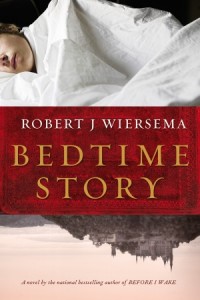
One of the last books of 2010 that I read was Robert J. Wiersema’s novel Bedtime Story, and I loved it. So much so that I wrote to Robert J. Wiersema (and yes, it’s fun to type Dear Robert J. Wiersema) and asked if he would mind answering a few questions.
Robert and I are friends from my old book publicist days at Raincoast Books so 1) he didn’t mind and 2) it gave us a chance to have a little catch up on the state of retail during the holidays. Here’s our Q&A about Bedtime Story, which is a story within a story about a struggling author and his 11-year-old son who gets sucked into an adventure tale.
Christopher Knox is the struggling author/dad who buys his son David an adventure novel about Davfd. David gets pulled into Davfd’s story. This leaves David in a catatonic state and puts his father on an adventure to figure out how to save him.
SoMisguided: Structurally, did you think about the length of Davfd’s sections or how frequently they occurred in the narrative? I noticed that before David’s first seizure, I was really pulled into that section of the novel. It seemed like there was a period of greater attention on that story. Then after the seizure, I felt more in Chris’ world as he tried to sort out the cause of David’s seizures. The end of the novel was like the confluence of two rivers.
RJW: Well, the confluence thing was definitely deliberate, and I’m thrilled to hear that it worked.
I think the earlier sections of Dafyd’s story were more compelling for two reasons: there’s a lot of set-up to them (a whole world to get to know), and, in contrast, there’s very little actually happening, narrative-wise, in Chris’ story. It’s more exciting to read about a kid being drawn to his destiny than it is to read about a marriage dissolving.
As Chris’ story gets more interesting, and develops more momentum, it draws more attention, and pulls together the stuff from the first section. That was the plan, at least.
(SPOILER ALERT)
SoMisguided: Is there a sequel? When I finished reading, I felt like you didn’t tie up the storyline for Tony Markus. His uncle did send a woman to seduce Chris and get the book. Then Tony is murdered? As a mobbed up uncle, I’d be curious about that and I’d certainly investigate where Chris was. And as Jacqui noted, Chris’ location was discoverable within 2 days. In my wild imagination, Big Tony comes looking to revenge the death of little Tony. Chris and David then use white magic with the help of Nora and Sarah. What do you think? No, eh. Well, why no close for Tony? He’s just a scummy NY editor who no one will miss? Heartless Rob.
RJW: I’m teaching a session at the Ontario Writers Conference in the spring called “Killing Your Darlings,” which is apparently about being merciless to your characters. Rumours of my heartlessness are clearly spreading.
There’s certainly a story that COULD be written about Uncle Tony following up his nephew’s murder , you could write it! I likely won’t.
And no, there are no plans for a sequel. To my mind, the stories of these characters are told, at least as far as they interest me.
That being said, there’s one strand that I think may be picked up in the future. I’m fascinated by Tara Scott, the student who Chris meets who’s reading his book. In the first draft of Bedtime Story, there was a lot more about her (such are the perils of streamlining a book , all that material ended up on the cutting room floor). I think I’ll be seeing more of her.
SoMisguided: Your first novel, Before I Wake, and Bedtime Story both have characters who have seemingly fallen into a coma but who are certainly part of the story. How do you imagine the world? Do you believe in planes of existence? Ghosts? Alternative realities? Or just a good storyline?
RJW: Well, the safe writer in me says “I’ll do anything, imagine anything, for a good story. It doesn’t go beyond that.”
Truth be told, though, I think there’s more to the world than meets the eye. I believe in ghosts, and synchronicity, and destiny. I have no reason not to believe in faeries. Science tells us that there are countless billion parallel universes; why is it so hard to accept that there is another world alongside this, separated from us only by the thinnest of membranes?
Stephen King wrote, in one of The Dark Tower novels, “There are other worlds than this.” When it comes to how I view the world, that pretty much sums it up.
SoMisguided: What books did you read as a boy? Did you have particular authors or genres you pulled on in this novel? I saw mention of the background story of Bedtime Story in the Globe & Mail and of a long-lost author who you Googled, but other influences?
RJW: When I was a kid, I adored the Madeleine L’Engle books – Wrinkle in Time and Wind in the Door. A Swiftly Tilting Planet came later. I loved the John Bellairs horror novels, starting with The House with a Clock in Its Walls , I think a lot of who I am as a writer came out of those. I liked the series books, especially the Alfred Hitchcock & The Three Investigators books. My first adult books were similar — Ian Fleming’s James Bond books at the high end, the trashy Executioner and Nick Carter series at the low. And of course Stephen King. Of course.
I was twelve when I stole and read The World According to Garp. It changed my life. To my mind, that’s the last book of my childhood, and the first book of my adulthood.
SoMisguided: What’s it like to be a dad and author to an 11-year-old boy? My mom was a cartographer and she’d frequently illustrate a page for me to colour. I didn’t realize colouring books existed as a commercial product until I went to school. I assumed every mom just spit them out. Does Xander get creative throw aways from dad or does he have to wait for the official publications like the rest of us?
RJW: You should probably ask Xander this … or not.
I’m not sure what he would say.
He pretty much has to wait. And wait longer. I wrote the fantasy scenes of Bedtime Story with him in mind, but he hasn’t read it, as yet. It’s still a little old for him. And the domestic scenes would be … odd for him, I think.
SoMisguided: Anytime an author has elements in a story that could be biographical, journalists always seem to ask about what plot lines are based on their real life. Are you annoyed by those questions? Perplexed? Amused?
RJW: I was expecting them, with this one. How could I not be?
I’ve learned , from the West Wing! , not to accept the premise of a question that I’m uncomfortable with or unwilling to answer.
In the novel, David is initially dismissive of the book his dad gives him as a birthday present. Have you ever received a birthday present (or given one) that you didn’t appreciate at the time but did later?
RJW: Wait, what?
I think the act of giving is one of the most intimate acts of which a human being is capable. This is especially true of books. When you give a book, it’s an act of giving part of yourself, and the recipient has an obligation to bear that in mind and act in accordance with the significance. (See what I did there? With the premise of the question?)
(SoMisguided: *chuckle*)
SoMisguided: David’s book title is The Four Directions. What four directions does the title allude to , can it be as mundane as NSEW?
RJW: It really IS that mundane.
And now I’m really sorry that it is.
SoMisguided: What’s question has no journalist asked yet about the book, which you think is an oversight?
RJW: I was hoping that I would have the opportunity to talk more about gender. To my mind, Bedtime Story is very much an examination of what it means to be a man, a husband, a father, at a time in which the traditional expectations of those roles have largely been overturned, but replaced only with confusion and uncertainty.
Sadly, no one has asked.
Bedtime Story by Robert J. Wiersema
Published by Random House
Robert J Wiersema’s is also the author of Before I Wake.
Thanks Rob for the interview! Again, I loved the book.
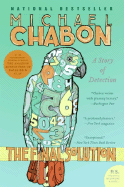 I know Michael Chabon’s work only because of his Pulitzer-winning The Amazing Adventures of Kavalier and Clay, but I recently borrowed a copy of The Final Solution: A Story of Detection from my friend Julie, who enjoyed the novel, as did I.