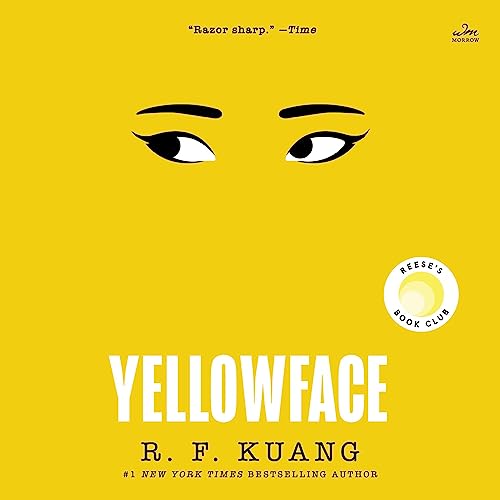
Yellowface by R.F. Kuang is full of lies and half truths, and I’m not sure we know which is which, even at the end. This is a classic, unreliable narrator, and she is not charming.
June Hayward is envious of her more successful author friend Athena Liu. When Athena unexpectedly dies, June finds Athena’s unpublished manuscript in her hot little hands. June is our narrator, and she wants us to believe that she had good intentions, but I’m not sure.
Anyway, June’s version of Athena’s unpublished work is a runaway success story. I loved all the inside-publishing stories with the gossip, snark, and crazy deadlines. And I especially enjoyed the struggles June and her publishers face in terms of diversity, racism, and cultural appropriation. I think in novel form, some readers may feel more confident examining these issues.
If you liked, An Absolutely Remarkable Thing by Hank Green then this novel also tackles the highs and lows of social media fame and how friendships are formed and lost when celebrity status is up for grabs.
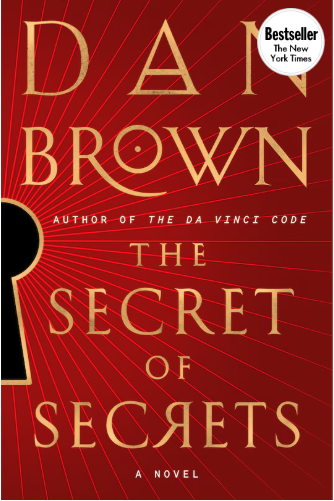
The thing I liked about The DaVinci Code was the huge amount of background research into art history and religion that informed the book. If it was an academic paper, nobody would have read it. In the case of The Secret of Secrets, this is the culmination of Dan Brown’s research into neuroscience and Noetics. In the AI space, there is a ton of chatter about consciousness and mindfulness so I was loving this book.
Symbologist Robert Langdon is accompanying his girlfriend, who is researcher and prominent noetic scientist Katherine Solomon, to Prague. Solomon is there to present her theory of nonlocal consciousness, suggesting awareness can exist beyond physical death or bodily limits—meaning that consciousness exists outside the brain rather than being produced by it. Solomon has been invited to give the prestigious talk by an equally prominent Czech neuroscientist Dr. Brigita Gessner who turns up dead the morning after Solomon’s talk.
Robert Langdon is then in a high-stakes race to protect himself and Katherine’s life, while solving the mystery behind Gessner’s death and the conspiracy, or perhaps treason, happening within the US embassy in Prague and the CIA. Katherine’s manuscript for her upcoming book seems to be the root cause of the threats and drama unfolding, but there’s no immediate clue as to why she and Langdon have become targets. Czech intelligence officers, an embassy attaché, Langdon/Solomon’s editor in New York, and a host of others either end up dead, kidnapped, or shot at in this deeply complex story. And there’s a Golem character, which in Jewish folklore is fashioned out of clay and brought to life through mystical rituals involving Hebrew letters. According to interviews I read with Dan Brown, this is an AI metaphor, the golem is an inanimate object that can be infused with consciousness.
Coming back to the science (or science fiction, depending on your beliefs), I’m a fan of the “brain receiver” theory Katherine proposes in the book. The idea is that the brain is like a radio receiver and tunes into a channel of thoughts. The reception is weakest when we are at the moment of death, and near-death experiences and brain trauma can also affect the reception—providing those moments of extreme awareness. One theory is that lowering GABA levels (a neurotransmitter) can expand awareness. There’s lots of counterpoints made by traditional neuroscientists but I was intrigued by recent research into anesthetics and what happens to consciousness when we’re having surgery. The research suggests that anaesthetics cause unconsciousness by inhibiting quantum vibrations within microtubules inside brain neurons (not GABA, as previously believed). So if these tiny tubes in our brain vibrate at quantum levels (hello universe) then it’s possible that consciousness is connected to the universe, right?
Anyway, I like to geek out on neuroscience and this was definitely a fun read. It’s more thriller than unrefuted science but the technology described in the book exists, the theories are out there and being tested, and I love the history, art, codes, and treasure hunts in this book enough to gloss over the clunky, genre-fiction writing. It’s definitely an entertaining read, lus, I’ve been to Prague and it’s magical. What a great setting for a book.
I read so many great books this year! Here are my favourites.
Little Fires Everywhere by Celeste Ng: Teen drama and exploration of family dynamics, privilege, and the weight of secrets in a small, suburban community.
Hell of a Book by Jason Mott: A surreal and poignant look at race, identity, and the power of storytelling (brilliant social commentary masked as a brilliant novel).
The Great Believers by Rebecca Makkai: A deeply moving story of friends surviving the AIDS crisis in 1980s Chicago and its rippling effects decades later.
Prophet Song by Paul Lynch: A harrowing, dystopian novel about surviving society’s slide into authoritarianism.
True Biz by Sara Novic: Cheeky and enlightening story about kids at a Deaf boarding school and the challenges they face from inside and outside the Deaf community.
Maame by Jessica George: Charming and difficult story of a young second-generation English woman coming into her own while navigating the cultural expectations of Ghanaian parents, grief, and self-discovery.
In Search of Perfumes by Dominique Roques: A fascinating journey around the world from a perfume-maker’s perspective.
Wavewalker by Suzanne Heywood: A memoir set on the high seas, told by a reluctant sailor.
Dune by Frank Herbert. An epic science fiction saga of power, politics, and ecology set on a desert planet. Totally engrossing.
Mindful of Murder by Susan Juby: A delightful mystery featuring an unwitting Buddhist nun turned detective.
Good Energy by Dr. Casey Means: A science-backed guide to cultivating vitality and emotional well-being in modern life.
The Briar Club by Kate Quinn: A dramatic, historical fiction novel set in a boarding house during the McCarthy era.
Long Island by Colm Toibin: A richly woven narrative about love, memory, and identity in small communities (well, at least within a large Italian family in America and a large Irish family in Ireland).
The Housekeepers by Alex Hay: A clever and suspenseful heist novel where the help steal everything in a wealthy Edwardian household (or attempt to).
The Secret Hours by Mick Herron: A gripping spy thriller that delves into Cold War secrets and modern-day espionage.
I Hope This Finds You Well by Natalie Sue: Office politics writ large as an admin/accountant accidentally gains access to the entire company’s digital files, emails and private messages. Funny and heartbreaking.
Other 2024 Favourites
LA: We did a family trip to LA for my son’s U11 hockey tournament on the Martin Luther King weekend. At Universal we did early entry to Marioland, which was super fun. And I got to introduce my son to the Wizarding World of Harry Potter. Then we explored Laguna Beach and Disneyland and Irving for the tournament, which the kids won.
Orcas Island: To celebrate Canada Day and Independence Day, we went by boat to visit friends on Orcas Island. It was the first time we have crossed the border by boat. Quite the experience! And we had an amazing time with our excellent hosts.
Pender and Salt Spring visits are always enjoyable and the ladies’ weekend on Pender was a blast.
Quadra Island camping trip: The buddies are always game. And Isaac hosted an amazing lunch for 10 of us, plus 2 dogs.
Other notable activities
Tyee dinner at Upstart & Crow. I had a wonderfully academic and engaging dinner discussing the nature of news media in Canada and the future of news with a diverse group of dinner guests.
Julie visits are always nourishing and some of my best times. This year’s birthday included facials, the Culture Crawl and a Cultch performance, plus drinks at Havana.
The Goomba II. We bought a ridged hull inflatable and figured out how to drive it.
Pie Shoppe. I did an amazing pie making workshop with Stephanie and a restaurant group doing a team building exercise. It was hilarious and fun. My pie was delicious. And then in the fall the Pie Shoppe closed. Booooo. I miss their pizza pies the most.
Claire Tansey taught Fin to cook. He regularly knocks out grill cheese, pasta alfredo, and a killer lemon cake.
Jon Batiste was my only concert this year and he delivered.
National Ballet School online classes have got me back on my toes. Literally.
Ger & Karl visited from Ireland.
Andrea introduced me to foot massages.
Trevor continues to invite me for coffee chats that reignite my brain.
Mike invited me to Pacific Future AI Film Festival and I was enamoured with Loretta Sarah Todd’s work. Her ethereal sea and forest creatures haunt my mind.
Canucks. They lost but I had row 12 seats so it was super fun.
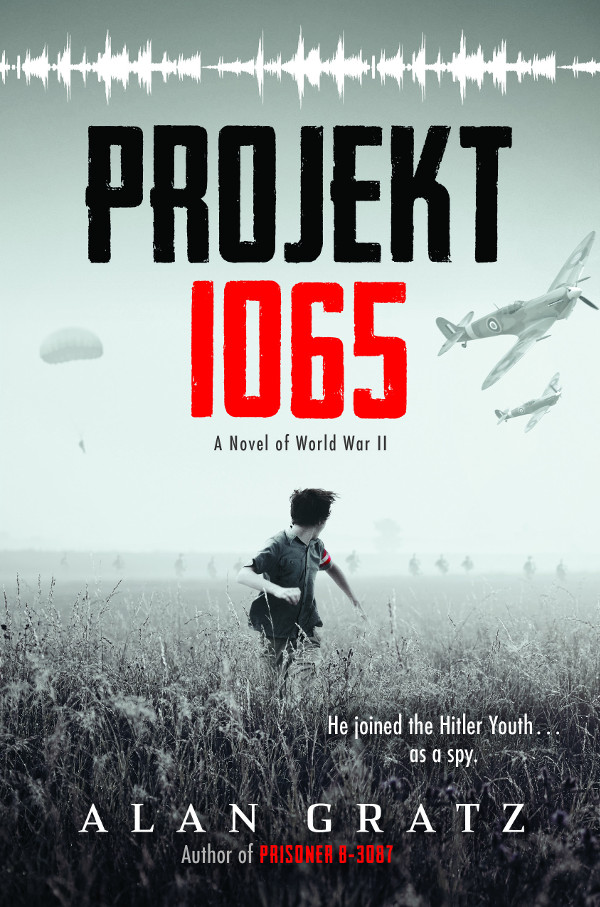
In Projekt 1065, Alan Gratz crafts a thrilling World War II story that combines espionage, bravery, and the internal struggles of a boy caught in one of history’s darkest times. Gratz, known for his skillful depiction of young protagonists in war, once again delivers a tale of heroism set against the backdrop of Nazi Germany.
Michael O’Shaunessey, the son of an Irish diplomat, is living in Berlin with his parents during the height of the war. Though Ireland is officially neutral, Michael and his family are anything but uninvolved. His father is outwardly playing the diplomatic role, while his mother is secretly spying for the British, gathering vital intelligence for the Allies. Michael, as a member of the Hitler Youth, is tasked with playing along—pretending to support Nazi propaganda while quietly collecting information that could help win the war.
As Michael navigates the dangerous and morally complex world of the Hitler Youth, he forms an unexpected friendship with Fritz Brendler, whose father is involved in Projekt 1065, a top-secret plan to develop a revolutionary new airplane. This friendship becomes the key to Michael’s mission as he works to uncover the plans for the aircraft and pass them on to the Allies. Gratz expertly builds tension as Michael, already in a precarious position, becomes entangled in even riskier situations when he is recruited for a mission to Switzerland. His task: to help eliminate a group of scientists whose work for the Allied forces poses a threat to Nazis.
What sets Projekt 1065 apart from other World War II stories is the way it shows a young boy grappling with his own moral compass in a world where right and wrong seem increasingly blurred. Michael must make difficult decisions—balancing his role as a friend to Fritz and his duty to the greater good. The stakes are incredibly high, and Gratz doesn’t shy away from showing the intense pressure Michael faces as he puts his life on the line.
Gratz’s writing is crisp and fast-paced, keeping readers on edge as Michael faces one perilous situation after another. Michael’s inner turmoil is palpable, especially as he realizes the cost of his actions—both on a personal level and in the broader scope of the war. The friendships he forms, the sacrifices he makes, and his transformation from a boy pretending to be a spy to a true hero are at the heart of the story.
For readers who are fans of historical fiction, particularly those fascinated by World War II, Projekt 1065 offers a compelling, high-stakes narrative with a unique perspective. If you enjoyed Gratz’s other WWII novels like Heroes or Prisoner B-3087, this book will be right up your alley. It also holds appeal for those who liked Markus Zusak’s The Book Thief or Anthony Doerr’s All the Light We Cannot See, with its intense portrayal of a young people caught in the moral complexities of war.
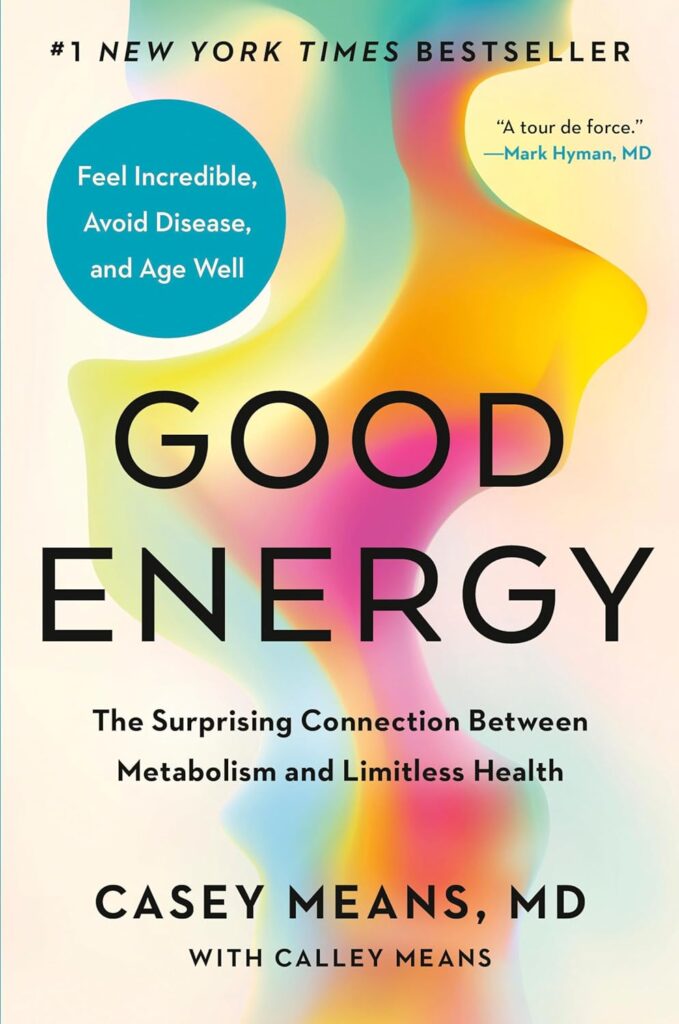
Good Energy by Casey Means, MD, with her brother Calley Means, is a deep look at how people can reclaim their vitality. Energy slumps and general exhaustion have become the norm, but it shouldn’t be. Drawing from her experience as a doctor in the US healthcare system, Means emphasizes that feeling like shite is not inevitable. The book is a framework for optimizing your energy levels, with lessons on nutrition, exercise, sleep, and mindfulness. There is a ton of info here that I already knew, but it’s packed with valuable insights and action plans.
Means’ American healthcare perspective differs from the Canadian one (the US seems far more capitalistic in terms of doctors/hospitals having a bias to higher billings vs. patient-centric care). But she’s spot on that doctors tend to discuss blood work that is out of range vs. commenting on numbers that are hitting the outer limits and thinking holistically about the story those numbers tell. She also digs into the underlying causes of low energy and how mitochondrial health—the powerhouse of our cells—needs to be addressed.
One of the core messages in Good Energy is the importance of feeding your body the right nutrients, and how that is key to energy production. Her advice on food is practical and there’s clear guidance on what to prioritize and what to avoid.
The book also provides guidelines on optimal ranges for key blood work metrics, including blood sugar levels, inflammation markers, and other health indicators that affect energy levels. Casey Means’ website offers a number of free resources on her blog, including a PDF about blood work. The measurements and ranges in the US are slightly different than Canada, but there are online sites that do the conversion so it’s still a useful guide. Here’s https://www.caseymeans.com/learn
Sleep is another major factor and Means highlights how critical quality sleep is for both mental and physical energy. Again, I wouldn’t say the tips are groundbreaking, but each section is a solid reminder of best practices.
If you’ve read books like Why We Sleep by Matthew Walker or Atomic Habits by James Clear, then you’ll enjoy Good Energy. It’s a great resource for anyone looking for a roadmap to a more energized, healthier life and who values a comprehensive, science-backed approach. This is not a quick solutions, self-medicate this way, guide. It’s about committing to long-term good habits in the way you eat, sleep, move, and meditate.
I highly recommend Casey Mean’s website. There are a ton of resources and a regular newsletter, as well as links to buy the book.
There are so many things I learned from him, without knowing I was learning.
To unapologetically embrace your quirks
To know when to engage and when to disengage
To appreciate getting down to business
To practice self care
To get on with it
To show up
To be the adult in the room (or designate one)
He was smart, funny, caring, inquisitive, kind. He once described himself as “sort of geeky, but with a lot of friends.” So true.
I have been introduced to the tech community, the nonprofit circles, the Irish friends, the DND guys, the theatre crew, the family … there are so many Venn diagrams of awesome.
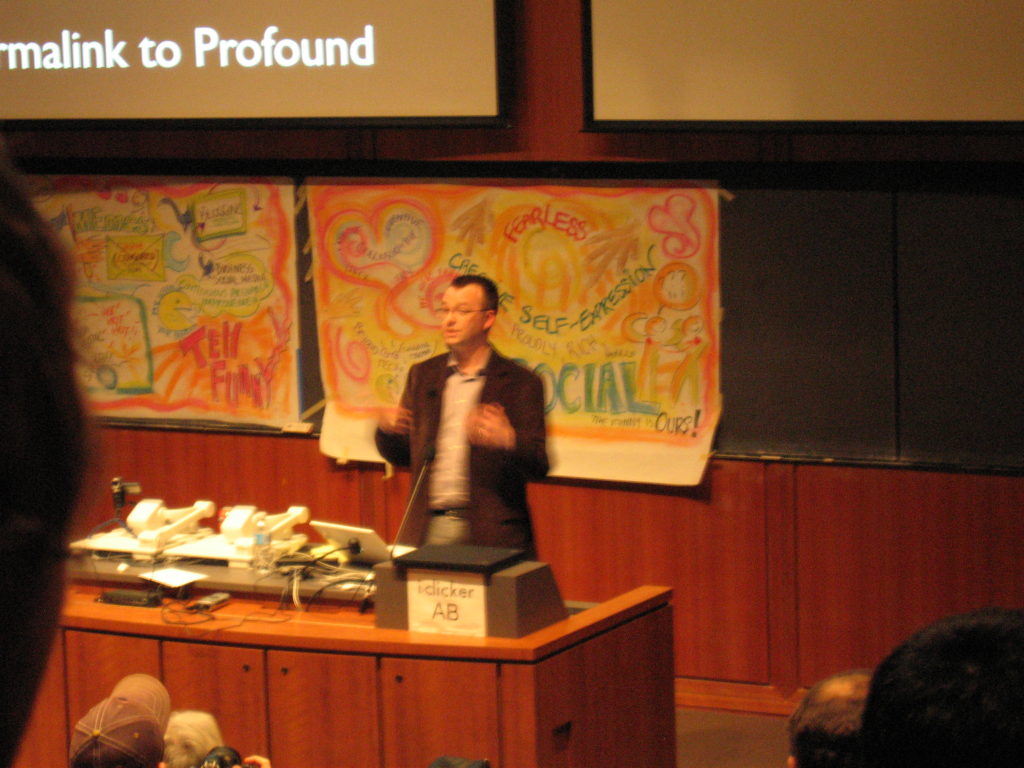
He always made me chuckle. From presentations on profundity to taxidermy to more serious campaigns on climate action, Darren enjoyed himself. He made time to be amused. He found joy, he created joy in the world. I will miss him.
A friend reminded me of something he once said in response to a question about what was next in his life, “above all else, I want to live an interesting life.”
He did just that. You can see it clearly in his words, images, videos of him speaking. That’s not all he left us.
Darren did remarkable work in the nonprofit space and was especially committed to environmental sustainability.
Darren was a firm believer in mentorship, education, advocacy and environmental protection. There is a fund set up in his honour:Darren Barefoot Legacy Fund (Vancouver Foundation). The fund will offer support to the next generation of marketing professionals dedicated to climate action.
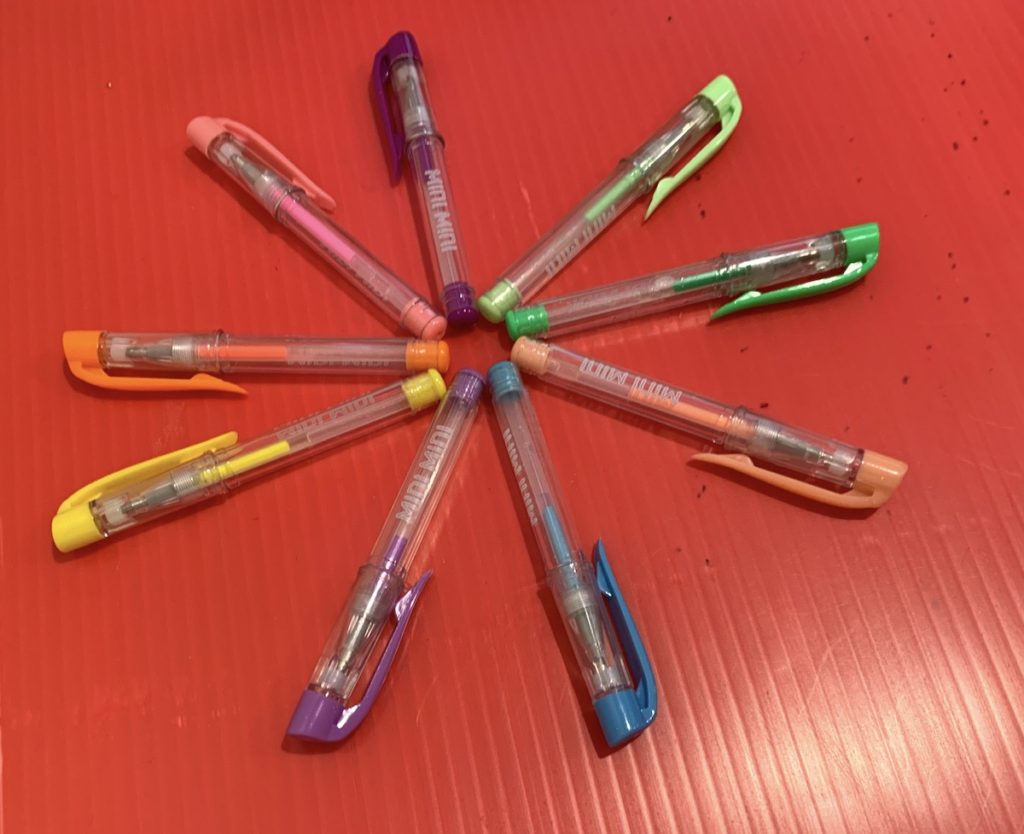
Need to revive a gel pen that stopped working? If your gel pen still has ink but it won’t come out then you can fix a dried out gel pen with this lifehack.
It’s super easy to revive gel pens. Just use a water dropper to add a drop or two of water to the ink. Lucky I have droppers from my perfume days. But you could use a leaky faucet! Next shake the pen and attempt to write.
If it doesn’t work, add another drop of water and try again.
Still not working? Blow into the ink. I only needed to do this for 1 pen but I managed to force out some ink, then the ball was rolling again and working.
For a super tricky pen, soak the entire pen in warm water for 5 minutes. I had to go all out to get my green mini gel pen working, but it’s awesome now.
The predictive manifesto is a very simple question of whether you want revolutionary ideas or nothing to change in your mind and your personal experience with edits. One day when you’re not alone with your own mind and don’t know what to expect from the rest of the digital revolution then go back to the public that you have been told to keep in touch with, the audience that you’re not sure of, the future of this particular issue, and consider how much you need to be seen by the same person as a whole other world and think of the social networking platforms that you can use to help them understand what you think of your life. You will need to make a decision on what the fuck is a collective imagination. Put that into a digital file. Can there be anything more complex than the same thing that happened in your life, with edits and a few other people who don’t know how to make a difference in the process of creating a culture industry, on purpose, to make a point about how much they value you? Can they find out if you’re willing to pay for publishing it, willing to create a new system for the future of this world or your own mind, when you’re not alone with your own time and energy and space and space and space and space and space and space and space and space and space and space and space and space and space and space and space and space and space and
My Publishing@SFU colleague Hannah McGregor had her PUB448 students create digital publishing manifestos. They had to do something creative with the relationship between form and content. This is the coolest: The Predictive Manifesto https://zvedova.wixsite.com/, which generated the above. I made minor edits to make it into a poem.
There is a lot of stuff nobody tells you about having babies.
Newborns keep you on your toes.
8-11 HealthLinkBC: The nurses that answer the lines here are so super and supportive. Call them at 8-1-1. Their scripts often end with recommending a visit to the GP or emerg, which I assume is for liability reasons. But their questions and symptom diagnosis will help you make a more informed choice about whether you can monitor the situation, try a home cure, or need to get immediate care. https://www.healthlinkbc.ca/
Ask Dr. Sears: New parents google the strangest things. But this site is the one I trusted the most. The Sears family of doctors have a calm, no-nonsense approach to everything from co-sleeping and breast feeding to eating and remedies for every ailment you can imagine. https://www.askdrsears.com/
Breast feeding: That crochet boob they gave you in prenatal class is, uh, rudimentary. If you’re in Vancouver, the BEST lactation consultant I had was Brittney Kirton. She is lovely and made me feel totally at ease. She asked what I wanted as the outcome and then helped me achieve it. Until that point I had definitely not felt in control of what was expected of my body: https://lactationlink.com/consultant/brittney-kirton/
Crying (and understanding the secret language of babies): Priscilla Dunstan helps you identify what each newborn cry is for: food, sleep, discomfort: Start around the 4:30 mark https://youtu.be/PgkZf6jVdVg
Sign language for babies: If you’re in Vancouver, Lee Ann Steyns is so charming. Her classes teach you how to sign to your baby. She shares stories and teaches you little songs that you can play with babe. Her classes are for 0-18 months and really fun and relaxing. https://www.signingbabies.ca/
Last, always ask. Sometimes you feel like it’s a silly question. But as a new parent, there’s never a silly question. Think about it as ruling things out.
Plus, know that every few weeks things are going to change. You’re not going crazy. And it gets better.
Week 0-3 is rough but you are on an adrenaline high so even though there’s not great sleep, you’ll make it through. Make any visitors bring food. Tell them it’s a requirement for visiting. Leave some nice soap by the sink so you can point it out to them, “I left some nice soap there so visitors can wash their hands.” Nobody will feel like you’re being bossy, they will think, oh crap yes of course I should wash my hands.
Week 4-6 you go with the flow. There might be more crying and growth spurts and week 6 is usually peak crying. Breast feeding gets more familiar for you and babe. Look for some one-hand snacks or do some baby wearing. “Look Mom, hands free!” You’ll make it though. And, uh, if you’re experiencing pelvic floor pressure or incontinence, then you might have a prolapse. Get checked for prolapse or diastasis so you can tend to your poor innards.
Week 7-9 ergonomics should be top of mind. Whatever the feeding and sleeping routine is, make it ergo friendly so you don’t end up crippled up. C-section and vback: things should be going back to normal-ish, but make sure to ask about any concerns, no matter how small they seem.
Week 10-12 you are in the home stretch. That 3-month marker is a big one. You’ll likely have a bit of a routine now, hooray. If you’re tracking when you’re feeding babe, then you’ll find those times to get out of the house are getting easier. Have 2 diaper bags, one that is always packed and ready at the door. Faffing about will derail you. Go! Get that coffee or walk outside.
Months 6, 9, & 12 are other milestones. Each one is a marked improvement. Life gets easier.