The World by Bill Gaston is this month’s Vancouver Sun Book Club read and I’ve been enjoying re-discovering Gaston. I was first introduced to his work when I was at Raincoast and I’ve followed his career but haven’t really dipped into his books. Too bad I waited!
The World is both the title of this novel and the title of a novel in the book, written by Hal, one of the main characters. Hal has Alzheimer’s and is in a home and we don’t really get to his story until the final third of the book, but he is introduced early. The book begins with the sad life of Stuart Price who is a high-school shops teacher, recently retired. Stuart is split from his wife and has poured his energies into paying off his mortgage. Indeed he has just paid it off in a lump sum and, in burning the mortgage papers on his deck, burns the place down. Oh Stuart. To add insult to injury, he has forgotten to pay his insurance premium.
Stuart’s meltdown, or rather burndown, takes him on the road. Whether he’s running away or running to somewhere is questionable. He’s swiftly decided to drive his ancient Datsun from BC to Ontario in order to visit his long-lost friend Mel who is dying of cancer. It happens that his insurance company HQ is in Toronto and he wants to plead his case in person.
Stuart is hilarious, and a bit insane, so his third of the novel is pretty funny. The middle section begins with Mel bailing Stuart out of jail and continues from her perspective. It’s a bit dire in comparison to Stuart’s tragedy, but really it’s just another personal crisis from a different perspective. With Mel, we also finally meet Hal, author of The World which is about a leper colony on D’Arcy Island. Hal is quite the character and he and Stuart together are certainly a pair of looney tunes.
We’re going to be discussing Bill Gaston’s The World for the next couple of weeks in The Vancouver Sun so I’ll save my thoughts for that.
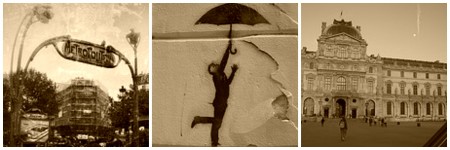
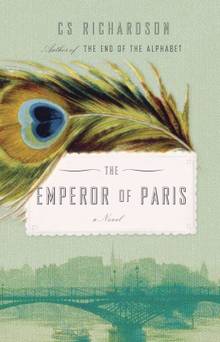
The Emperor of Paris by CS Richardson is a series of short, interconnected love stories set before and after World War I in Paris. The most prominent storyline is of Emile Notre-Dame, thinnest baker in Paris and his wife Immacolata, who have a son Octavio. Both father and son cannot read but are amazing storytellers and Boulangerie Notre-Dame becomes rather infamous among its regular patrons who come for the buttery croissants and baguettes but also for the stories.
Quote: The bakery occupied the ground floor of a narrow flatiron building known throughout the neighbourhood as the cake-slice. As far back as anyone could remember the letters above its windows, in their carved wooden flourishes, had spelled out:
BOULA GERIE NOTRE-DAME
the N having long since vanished.
The story of the N’s disappearance is a regular request from the bakery’s patrons, the most fantastical version being about thieves who spread across France stealing Ns and the most favourite being that of Napolean stealing the N himself.
The love of books is another thread through the story. Despite not being able to read, Octavio is a regular buyer from a book stall near the Louvre. For both Octavio and the bookstall owner, books have a special meaning, and lead to friendships and relationships.
CS Richardson has crafted a very fine story indeed. His cast of characters each contribute to the overarching story while having their own backstories as well. Emile, Immacolata, and Octavio run the bakery as I mentioned. Then there’s the fashion designers Pascal Normand and his wife Celeste, who hide their daughter Isabeau from view because of a facial scar from an unfortunate childhood accident. And we have three generations of the Fournier family who own the bookstall. On top of that, there’s a blind watchmaker, a starving portrait artist and Madame Lafrouche whose husband Alphonse gifts Emile The Arabian Nights which becomes the first book in Octavio’s collection and eventually makes it into the hands of Isabeau.
I was first introduced to CS Richardson from my publishing ties. Richardson is an award-winning cover designer for Random House and his first novel The End of the Alphabet was my favourite book in 2008. The Emperor of Paris is a strong contender for 2013.
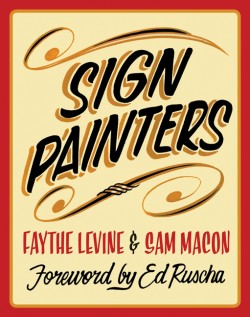
In 2010 filmmakers Faythe Levine, coauthor of Handmade Nation, and Sam Macon began documenting the dedicated practitioners of hand-painted signs, their time-honored methods, and their appreciation for quality and craftsmanship. Sign Painters, the first anecdotal history of the craft, features stories and photographs of more than 25 sign painters working in cities throughout the United States.
The Canadian premiere of the Sign Painters documentary that accompanies the book will be in Vancouver on June 7th and 8th at the Rio Theatre. Get tickets ($20) and additional information.
Michel Houellebecq’s The Map and the Territory is one of those books that makes the mind tingle. The novel’s caustic sense of humour and irony had me eagerly turning the pages and thinking fondly of Ayn Rand.
Like Rand, Houellebecq (pronounced “Wellbeck”) is equally controversial in his own way. His protagonist Jed Martin, an emotionally stunted and highly successful artist, befriends French novelist Michel Houellebecq in his quest to have Houellebecq write the catalogue for his forthcoming exhibition. The novel version of Houellebecq is a satirical fictionalization of the author himself. Houellebecq describes Houellebecq as having a reputation for drunkenness, strong misanthropic tendencies, and a fondness for charcuterie. Surprisingly he is brutally murdered in the third section of the novel.
Let me get to that in a second. In the first two sections of the novel, we experience the artworld through Jed Martin’s eyes. He approaches life with neutrality and often with distain, but it also seems understandable that he, like the reclusive, fictional Houellebecq, wants as little human contact as possible and the space to create his art. The modern art world presented in the novel is one of consumerism and one-up-manship, where Martin’s portrait-style paintings of CEOs and architects fetch millions of dollars and become cause for murder.
Yes, speaking of murder, the third section takes a distinct turn, both in perspective and writing style. Instead of the high-minded, sophisticated writing style of the first two sections, we get detective, genre writing. It’s quite the contrast.
The Map and the Territory isn’t a book for everyone, but I found it masterful. As Jed Martin’s father remarks, “he [Houellebecq] is a good author, it seems to me. He’s pleasant to read, and he has quite an accurate view of society.”
A hilarious text exchange yesterday morning led me to these thoughts:
John Green is hilarious. I didn’t know that.
One of my Pub355 students introduced me to his videos (and I should have watched them immediately).
Craig Ferguson is still hilarious (always knew that, loved his show, haven’t watched it for awhile, thought his novel was darkly funny).
I’m now addicted to John Green videos.
I’m ready to read The Fault in Our Stars (cancer story, couldn’t read that last year due to a family illness).
Here’s how it all went down.
SDS: Do you know John Green?
Me: I know Joslin Green (Boxcar designer).
SDS: John Green. He’s big on the internets. There’s a video clip where he goes on about being a big Harry Potter fan and going to conferences.
Pause
Wait. What? I’m a big Harry Potter fan and go to conferences. Who are we talking about?
(Search “John Green” and autocomplete brings up “John Green Books”)
End Pause
Me: Oh, John Green, author. I thought we were talking about someone I know personally. I know author John Green of The Fault in Our Stars. Harry Potter fan though?
SDS: Yes, the interview on Craig Ferguson is about his book. He goes to Harry Potter conferences.
Pause
I go to Harry Potter conferences. Who are we talking about?
(Search “John Green Craig Ferguson”)
Yes, yes. Same guy. Ok, the puzzle pieces of this text thread are coming together. John Green. Author. Interview on Craig Ferguson.
Watch 11 minute video (actually it’s not that long because the last 4-5 min are some other show promo). OMG funny, worth watching. I didn’t know how personable John Green is.
Discovery: Yes John Green is a Harry Potter fan and goes to conferences because his brother plays Wrock. (That’s Wizard Rock for those of you not in the Potterverse). I personally like the Mudblood’s “Be My Witch Tonight,” which I first heard at Portus 2008.
Who, then, is his brother?
(Search “John Green Brother”)
Hank Green. Thank you Wikipedia.
Ah! This is the guy behind “Accio Deathly Hallows”, which was super popular because it went viral before the last Harry Potter book was released. I know this (without knowing or connecting the details). Hilarious! This is a fun internet-browsing adventure.
(How are you liking the inner workings of my sleep-depraved, new mom brain? Fascinated, I’m sure. Thankfully this blog is called So Misguided.)
Next thought: That song launched Hank and John’s Vlogbrothers YouTube channel into the stratosphere, which is what my student Calvin was telling me in September. I clearly should prioritize reading/watching links sent to me, not just by students but by James, Boris and friends who diligently keep me up to date. Mea culpa.
John Green video‚ Mar 19, 2013‚ offers a great commentary on advertising and where marketers are going wrong when they think about social media and advertising. (See this is valuable, work-related research now.)
Plus, the video was filmed in advance of the Craig Ferguson interview so the neurosis of this video is a perfect complement to (my state of mine, ur, I mean) the actual interview itself.
I’m now addicted to John Green and most certainly want to read The Fault in Our Stars, which I wanted to read before anyway.
And here’s my work-related thought to show that a portion of my professional brain still exists … the video highlights a good point made by Jane Friedman earlier this week in her post on 5 publishing industry trends writers need to understand:
Quote: 3. The Value and Distraction of Author Platform Building
I’ll make a bold statement right here that I don’t think I’ve made before.
If you’re a totally new, unpublished writer who is focused on fiction, memoir, poetry, or any type of narrative-driven work, forget you ever heard the word platform. I think it’s causing more damage than good. It’s causing writers to do things that they dislike (even hate), and that are unnatural for them at an early stage of their careers. They’re confused, for good reason, and platform building grows into a raging distraction from the work at hand‚ the writing.
Therefore, build your platform by writing and publishing in outlets that are a good fit for you, lead to professional growth, and build your network. The other pieces will start to fall into place. It might take longer, but who cares if you’re feeling productive and enjoying yourself? Go be a writer and take a chance on the writing. Writing and publishing good work always supports the growth of your platform‚ and I’m willing to bet more valuable platform building will get done that way, especially for narrative-driven writers.
Exception to the rule: Nonfiction/non-narrative authors and entrepreneurial authors who are self-publishing. Sorry, but you should probably focus on platform as much as the writing.
I 100% agree. And when publishers are talking to authors about building a platform, they are looking for a John Green.
But you know what? Green is a total outlier. See above activities with Hank Green. Then look further back than Vlogbrothers. Vlogbrothers was predated by the Brotherhood 2.0 Project.
Quote:
John Green and his brother Hank ran a video blog project called Brotherhood 2.0. The original project ran from January 1 to December 31, 2007, with the premise that the brothers would cease all text-based (‘textual’) communication for the year and instead converse by video blogs, made available to the public via YouTube (where they are known as the ‘vlogbrothers’) and on their Brotherhood 2.0 website. Thanks again Wikipedia
Dear authors: a platform is often years in the making. Be realistic about the time you have available if you want to build an audience faster than that.
Dear publishers: See above point for authors.
A limited number of signed collectors’ editions of Alice Munro’s Dear Life and Yann Martel’s Life of Pi have been printed on straw paper and are being sold for $250-500. The special sale is a campaign to demonstrate the versatility of straw paper developed by Second Harvest Paper in partnership with Canopy. At present, 50% of forests cut in North America currently become paper. This new straw paper contains only straw left over from grain harvesting and recycled paper, with no virgin forest materials used at all, and therefore no damage to our limited forest ecosystems.
Quote:
Press Release (Vancouver) Celebrated authors Alice Munro and Yann Martel have collaborated with award-winning environmental group Canopy to print collectors’ editions of their bestselling books Dear Life and Life of Pi. Printed specially on forest-saving paper made from straw rather than trees, the books highlight a viable solution to logging carbon-rich forests for paper. Published by Random House of Canada, a limited number of signed copies of each book will be available from these printings. All proceeds go towards Canopy’s continued forest conservation work and development of alternative paper sources.
“Future generations will only know bears, tigers, orangutans and caribou as fictional creatures unless we protect their habitat in the Boreal, tropical and temperate forests now,” said Yann Martel, after last week’s Oscars win by the film based on his novel. “Using straw paper for my book demonstrates that there are elegant solutions that keep the world’s towering trees standing.”
Canopy arranged the production of these rare special editions with Random House of Canada as part of their campaign to diversify the North American paper fibre basket. Kick-starting commercial-scale development of straw-based papers will significantly reduce the stress on endangered forests.
“Now more than at any other time in our history, we need to bring our intelligence and imagination to sustain our life support systems,” said Alice Munro. “With a pure passion and unwavering conviction Canopy has been working to protect the world’s forests and inspire innovation. This is exactly the kind of practical solution required.”
Both Alice Munro and Yann Martel, and their respective publishers, McClelland & Stewart and Knopf Canada, have worked closely with Canopy since 2000 when the organization first started its work to green the book publishing industry. At the time, no publisher was consistently printing on environmental papers.
“A decade ago Alice Munro and Yann Martel were amongst the first authors to work with Canopy and their publishers to curtail books being printed on paper from ancient and endangered forests,” said Nicole Rycroft, Canopy’s founder and executive director. “Today, they are yet again helping to pioneer solutions that will keep more than 800 million trees standing in North American forests every year.”
Every year millions of tonnes of wheat straw and flax straw, left over after the grain harvest in Canada, could be used to make commercial-quality paper. As of February 2013 Canopy’s ongoing market survey quantified an annual North American demand for more than 1 million tonnes of straw paper. The paper used in Alice Munro and Yann Martel’s titles is made from wheat straw, flax straw and recycled paper, and has half the ecological footprint of conventional paper. It is the product of a unique partnership that Canopy forged with paper producer Cascades Fine Paper, technical collaborators at Alberta Innovates, and printers Friesens and Webcom.
Signed special editions of Life of Pi will be available for purchase beginning March 6, 2013. Signed special editions of Dear Life will be available for distribution as of mid-April 2013, in time for Mother’s Day, but can be preordered today. Both books are available exclusively at canopyplanet.org.
Canopy is a not-for-profit environmental organization dedicated to protecting forests, species and climate. Canopy believes collaboration is the key and that businesses can be a powerful force for solutions, and work with more than 700 companies to help ensure their supply chains are sustainable. Canopy’s partners include Sprint, The New York Times, Random House, Hearst, Scholastic, and Lonely Planet. For more information, visit http://canopyplanet.org.
Congratulations to author Chad Pelley, winner of the inaugural Salon Fiction Prize.
[Press Release] Saint John, N.B., February 21, 2013. The Telegraph-Journal, New Brunswick’s provincial newspaper, telegraphjournal.com, is ecstatic to announce that Newfoundland-based author Chad Pelley has won the inaugural Salon Fiction Prize for his short story, Second Look at Nothing.’
Launched July 2012, the Salon Fiction Prize awards $1,000 for a previously unpublished work of Canadian short fiction. The winning piece is also published in the Telegraph-Journal’s weekend fine arts and culture section, Salon. Second Look at Nothing is running in the Feb. 23 issue of Salon.
Chad Pelley’s short story was selected from more than 100 entries from across Canada by an esteemed Atlantic Canadian jury empanelled for the new prize: Giller Prize-shortlisted short story writer Alexander MacLeod; Halifax-based Atlantic Poetry Prize-winner Sue Goyette; and Universite de Moncton professor Thomas Hodd.
Chad Pelley is a multi-award-winning writer, songwriter and photographer from St. John’s, Newfoundland. His debut novel, Away from Everywhere (Breakwater Books) was released in 2009, and his follow-up, Every Little Thing (Breakwater Books) hits bookshelves in March. Recipient of the Newfoundland and Labrador Art Council’s CBC Emerging Artist of the Year award, Pelley is president of the Writers’ Alliance of Newfoundland and Labrador and runs the CanLit blog saltyink.com. See Chad Pelley’s author bio and book links on 49thShelf.com
About Salon
Published every Saturday in the Telegraph-Journal, Salon is home to some of the best arts and culture writing in Canada, honoured with both national and regional newspaper awards. As space and resources devoted to books continues to dwindle, and the CanLit landscape disappears from Canadian newspapers, Salon remains dedicated to supporting our nation’s writers and their words.
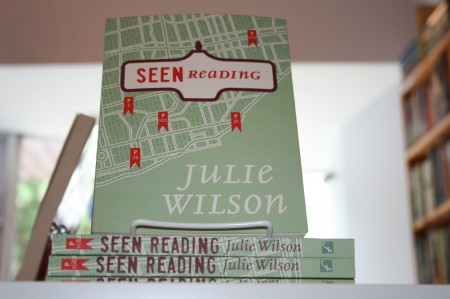
My last read of 2012 and it was written by friend and colleague Julie Wilson. A lovely end to a year of fine reading.
Source: jhgordonbooks.com
Also on the Globe and Mail’s top 100 books of 2012 list!
Seen Reading is a collection of microfictions written by Julie alongside literary voyeur spottings from her SeenReading.com heydays.
Quote: READER: Caucasian female, late 30s, with strawberry-blond hair, wearing brown skirt and lime-green blouse with sleeves rolled and buttoned at the elbow. Sunglasses sit in lap.
The Kite Runner
Khaled Hosseini
(Anchor Canada, 2004)
p 157
On the opposite page is “Ends” a short (short) story about a couple sitting at opposite ends of a couch and one of them noticing all the little age marks of the other before noticing her own flaws. When did this happen?
The book itself is a beautiful little object worth keeping on a coffee table or bookshelf. The paper and production quality is lovely and the contents are witty, quirky and worth savouring.
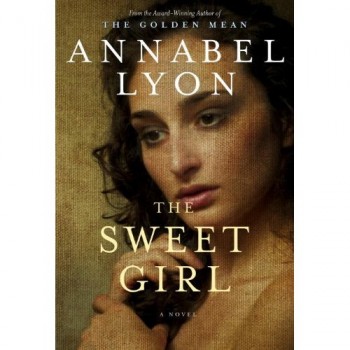
Here are a few highlights from the chat with Annabel Lyon on The Sweet Girl
On how The Golden Mean and The Sweet Girl work together
I was really drawn to Aristotle first and foremost, his intellect, and then I was stuck with the fact that he happened to be an ancient Greek – it was the philosophy that drew me first, the history second. But after I finished writing The Golden Mean, I knew my project was only half-finished. That was such a male book, but I wanted to look at the female world also.
Tips on writing dialogue
always, always, always read it aloud. That’s my first instruction to students. If it doesn’t sound natural aloud, it’s not going to read like natural dialogue. I also encourage students to make the dialogue do the work, and not rely on what are known as dialogue tags (she shouted menacingly, that kind of thing). Those are like stage directions, and for me they dilute the power of the line itself. And finally, in historical fiction, make sure your characters still sound like real people. I don’t think “Zounds, my liege, thou hast verily captured it” is nearly as good as “You got it,” even if you’re working with ancient characters.
In response to my question about routine in writing (whether for fiction, or in my case business writing)
Thanks for your question about routine, Monique. I’m not a big believer in the Romantic image of the writer–alone, suffering, pirate blouse in a garret somewhere, waiting for the muse. It’s a job, and I treat it like a job: dress professionally, go to the office, do your work. You wouldn’t procrastinate relentlessly if you were a lawyer or doctor or drywaller or barrista, and you shouldn’t let yourself do that as a writer, either. I like to compare creative writing to journalism, partly because my dad was a journalist, but partly also because there’s a huge overlap between the skill sets. A good non-fiction sentence and a good fiction sentence have a lot in common. A good opening to a short story and a good lede in a news story are playing on a lot of the same principles. And, similarly, I believe strongly that good creative writing can be taught, just as journalism can be taught. Inspiration, no, but craft, yes.
On factual references in the novel, in particular midwifery and stillbirths being buried with puppies
The puppies: yes, this was something I learned about on my trip to Greece. I was fortunate to travel with a university class from Carleton and U Winnipeg (I made friends with some academics, who let me tag along), and one of the things we got to do was learn about the work of Maria Liston, who teaches at Waterloo and also works at the American School in Athens. I joke that she could be the star of CSI: Ancient Athens, because her work focuses on things like bone remains. She can look at a bone and tell you what it is, how the person died, etc. She told us about her research into the remains of babies found in wells with puppies, and concluded that these were drops midwives used for babies who hadn’t survived. The puppies were one of those touches that was so bittersweet: awful, and yet you could imagine someone grieving the baby’s death and (in their belief system) wanting to send something cuddly with them, to keep them company. You can’t invent this stuff! And of course, as a fiction writer, you can’t pass it up either. I got her permission to use this.
On why I included The Sweet Girl in my Shoebox Project for Shelters package
Related to Golden Mean as a male world and The Sweet Girl as a female world, I’m participating in The Shoebox Project this year (final dropoff day is Monday!), where you put together a shoebox of gifts that are delivered to women in shelters. I felt that Pythias’ story was a good survival story, or at least showed how you need to keep your wits about you even when the world seems against you. So it’s included in my shoebox. http://www.shoeboxproject.com/
If you’re looking for a great gift this season for a reader then I highly recommend The Golden Mean and The Sweet Girl. A combo pack or singles.
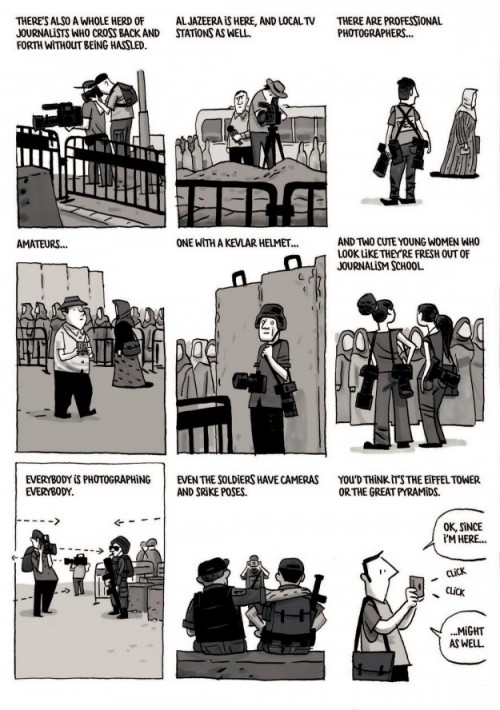
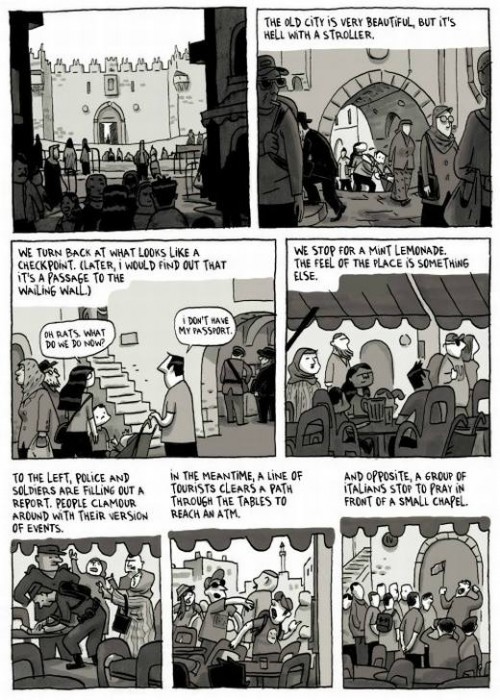
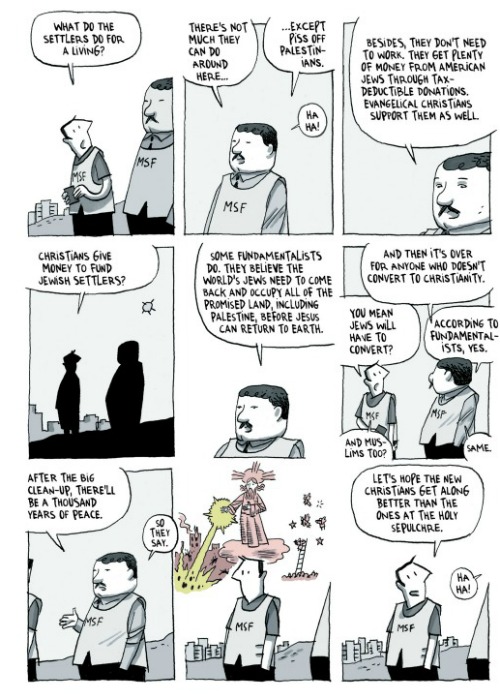
One of the magical things about a Guy Delisle book is the fly-on-the-wall perspective of countries that are inaccessible (or relatively so) to Westerners.
His previous graphic travelogues were about Burma, Pyongyang and Shenzen. I loved both Pyongyang and Shenzen, but Pyongyang has a special status as it was my first Guy Delisle encounter.
I’m not sure if having been to Jerusalem aids in the enjoyment and depth of Delisle’s account of the Holy City but I’d still recommend it to anyone curious about Israel or the Middle East in general as I think there’s a tone that runs through the region that is incomprehensible to most outsiders.
The book opens with the introduction of Delisle’s children. His parner Nadege is working with Medecins Sans Frontieres and the family is on their way to Jerusalem for the year. Guy hopes to work, as he’s done on other trips, while minding the children. (Good luck with that!)
The opening scene portrays a seemingly Russian Jew with concentration-camp numbers on his arm distracting Guy’s collicky child. They don’t share a language but Guy makes a ton of assumptions, and checks himself, all within a few frames, which really sets the stage for what’s to come. Jerusalem is a land of mixed emotions, assumptions, perceptions and deceptions.
Throughout the travelogue, we get treated to the differng points of view Delisle encounters: Israeli, Palestinian, Christian, and Muslim, as well as those of Medecins Sans Frontieres staff, Nadege, their cleaners and childcare providers, tour guides and reporters he meets along the way.
Delisle doesn’t claim to understand each of these perspectives and he has a certain skepticism or cynicism whenever strong binary positions are presented, but it’s a real treat to see Jerusalem from his vantage point of a year-long adventure vs a few days or weeks as a tourist. Delisle is in the region long enough to have some of his initial ignorance disappate and he has time to see the underside of the official messages or points of view in the press.
Although Delisle doesn’t offer a completely neutral account, he’s not judgmental either. Jerusalem is subjective observation but from a rather level head.


 The story of the N’s disappearance is a regular request from the bakery’s patrons, the most fantastical version being about thieves who spread across France stealing Ns and the most favourite being that of Napolean stealing the N himself.
  In 2010 filmmakers Faythe Levine, coauthor of
 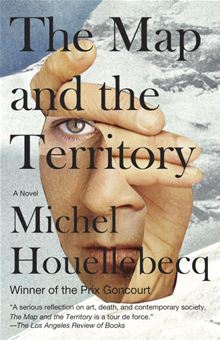 Michel Houellebecq’s The Map and the Territory is one of those books that makes the mind tingle. The novel’s caustic sense of humour and irony had me eagerly turning the pages and thinking fondly of Ayn Rand.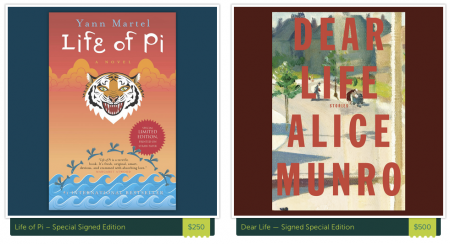
 Congratulations to author Chad Pelley, winner of the inaugural Salon Fiction Prize.