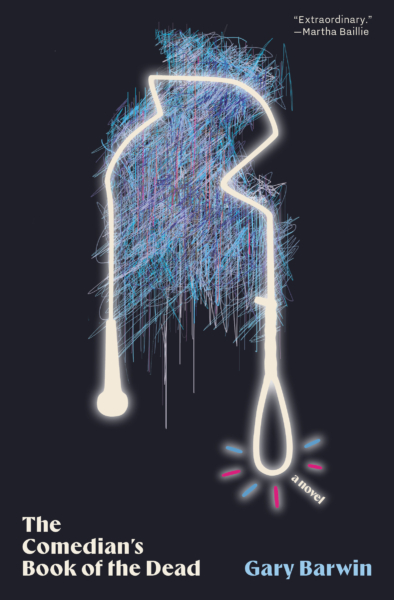
The Comedian’s Book of the Dead by Gary Barwin begins with a premise that sounds like the setup for a joke: “so this family man wakes up one morning as Death…”
Except, it’s not a joke, and this novel gets dark pretty quickly.
Death is not simply a new job title. The role begins to erode the man underneath. He starts, not just guiding people to the Beneath, but interfering in the lives around him, taking fate into his own hands, and making choices that are destructive to his family. His marriage falls apart. His relationship with his ex-wife and son become tangled in secrecy and control. Then his jealously turns violent. The suicide of Death’s son Grigory finally jars him into reflecting on the role he’s played and whether his actions can be forgiven.
The novel is positioned as a funny page turner but I found it more of a philosophical exercise looking at labels, roles, and the ways we become what we call ourselves.
Before he is Death, the protagonist is a struggling comedian, a husband, and a new father, adjusting to parenthood. I can’t say he’s successful at any of these roles. But what does it mean to be a good father? A husband? A comedian? And what happens when the label is not just some something you do, but something that determines how you behave?
Once he becomes Death, the distinction between role and identity starts to disappear. In this way, there’s a Kafta-esque nature to the story. He wakes up and one day learns he is Death. It’s like Gregor Samsa, the travelling salesman, in Kafka’s The Metamorphosis, who wakes up as a giant bug. That’s a story about dehumanization of work, conditional live, and alienation. Likewise our unnamed protagonist, now going by “Death”, is at first concerned about keeping up his comedy routine, but the routine just keeps missing its mark. When the job of bringing people to the Beneath becomes all encompassing, his family’s affection fades as the burden of his job alters his behaviour then his family’s views of him. Add to that, Death is deeply lonely, an outcast.
I imagine Death as a neutral figure. He arrives when someone’s time has come, rather than being the one deciding that it’s time. But Barwin’s Death doesn’t adhere to my idea of Death. His version of Death doesn’t respect the Fates, and increasingly he acts on his petty and insecure feelings, leading to disastrous consequences.
The suicide of Grigory is a pivot point and the story moves into an underworld journey that has echoes of Dante’s Inferno: a descent punctuated by encounters with people from Death’s life. His mother appears, his long-absent father, his wife, and ultimately Grigory. My sense is these reunions are less about restoring relationships and more about forcing Death into proximity with what he has lost. But why? His hope is to bring Grigory back, but it’s not clear that would be Grigory’s choice, so maybe the question is whether Death can come back from what he has become.
The book’s epigraph is from Edward Hirsch’s Gabriel
I wish I could believe in the otherworld
I wish I could believe in a place
Of reunions outside of memory
The Beneath becomes this place—a world outside memory where reunion is possible, although reconciliation may not be. And I think that’s the big question: is there redemption for Death?
Death is not an easy character to love. He is frequently jealous and I rarely felt that I could identify with this character. But maybe that’s Barwin’s goal, to force the reader to consider what redemption means when the person seeking it is not particularly deserving of sympathy?
Overall, I wouldn’t describe The Comedian’s Book of the Dead as a funny. It’s imaginative, sometimes poetic, and deliberately unsettling. I had to work pretty hard as a reader to find ways to like this book.
Here’s an interview with the author Gary Barwin on All Lit Up that sheds more light on the story.
I received an advance reading copy of this book and I love to support Canadian presses and authors. Check out bookhugpress.ca