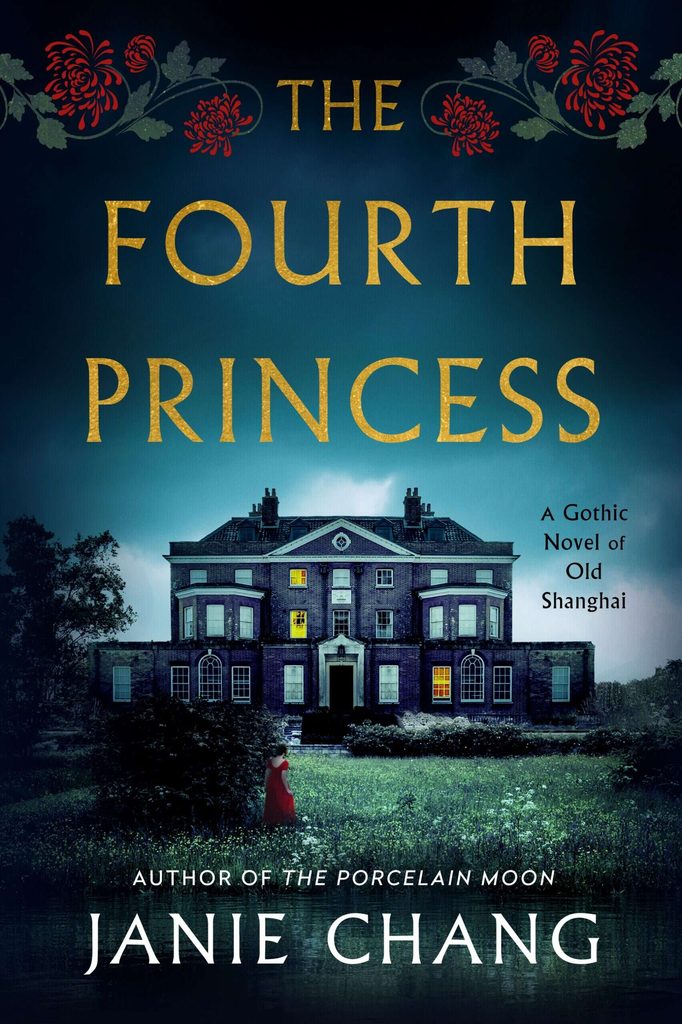
The Fourth Princess by Janie Chang is a Gothic novel set in 1911 Shanghai, where a crumbling mansion, family secrets, and a relentless ghost almost bring about the ruin of wealthy newlywed Caroline Stanton and her young secretary Lisan Liu. Notably both are orphans and have difficult relationships with their guardians.
Janie Chang is a master of historical fiction and her latest novel brings her distinctive Chinese perspective to the Gothic genre. The story follows two women living at Lennox Manor:
Caroline Stanton is a wealthy American whose husband Thomas has moved them to Shanghai so that he can follow a business venture with his Uncle Mason. Caroline soon discovered that Uncle Mason is heavily in debt, doesn’t own the home that he promised they would inherit, and likely doesn’t have money to invest in the railway venture he’s exploring with Thomas. Caroline discovers the secret and presses Thomas to reconsider, but Thomas is keen to invest her inheritance into the railway to cover Uncle Mason’s missing share.
Lisan Liu enters this already complicated household as Caroline’s new secretary. Upon her arrival, she learns from the servants that Lennox Manor is haunted. Mason’s son committed suicide and they believe his unsettled ghost haunts the home. Lisan discovers that the house is definitely not peaceful. Mason’s daughter-in-law disappeared around the time of the suicide and she appears in Lisan’s dreams, beckoning Lisan to come find her. Despite her restless nights, Lisan is a stalwart friend and efficient secretary to Caroline. Unfortunately Caroline is also holding secrets and they all come to a head and converge with Lisan’s own past.
Chang is so good at historical fiction and she certainly knows what she’s doing with Gothic conventions as well. Lennox Manor is the grand house with the ominous past and unexplained bumps and sounds in the night that drive the occupants a bit mad. There are money problems, marriages full of secrets, and a growing suspicion amongst all the characters.
The Fourth Princess is so enjoyable because of its familiar Gothic elements, yet unfamiliar cultural perspective and Shanghai setting. Chinese superstitions about the ghosts of suicides, the stylings of the house, the workings of the staff, the power of Lisan’s guardian and his family, all provide historical context to the broader political and social world of Shanghai in the early 1900s. There is the push-pull between Chinese and foreign residents, the class and family obligations of Lisan vs. the class and family obligations of Caroline, plus there is enough mystery to how Lisan and Caroline both became orphans and what that means for their futures that it’s a real page turner.
If you like Janie Chang’s historical novels, like The Porcelain Moon, or The Phoenix Crown, which she co-authored with Kate Quinn, then you’ll definitely enjoy this read.