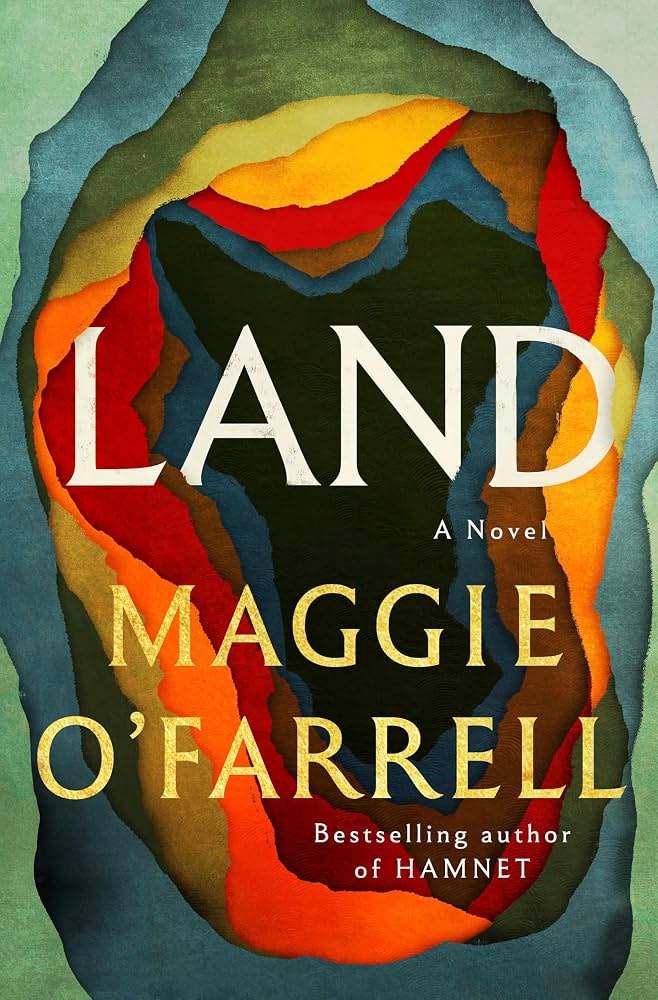
Land by Maggie O’Farrell is a devastatingly beautiful story about an Irish family struggling to survive in the 1800s. Tomás and his young son Liam are working for the British on their great Ordnance Survey, a project to map the whole of Ireland. It’s 1865, the Great Hunger has destroyed families, villages, and ways of life. Tomás is a skilled surveyor and mapmaker, and he’s keen to chart the losses and name changes in a way that honours the past. Liam is his reluctant chainboy.
Tomás calculations are accurate and his illustrations a work of beauty. But he’s seen as a labourer, a British superior puts his name on Tomás’s work and dismisses him until the next project starts.
What we learn through the novel is that Tomás is an orphan. His family died in the famine. He was sent to a workhouse and only escaped by demonstrating his skill in reading and writing. He’d love to pass on his passion for maps to Liam, but Liam is young, he has other interests, and he’s tired of standing in the wet and cold, holding the measurement chains for his father.
Everything gets much worse for Liam though when Tomás has an incident of madness after entering an enchanted copse and drinking from a fabled pool of water. Liam is afraid. He watches the village priest perform an exorcism, and Tomás is never the same. They return to their tenement in Dublin where Tomás stabilizes and is eventually forced back to work by his loving wife Phina who cannot support the family on sewing and laundry alone. She’s also pregnant with their fourth child Eugene, plus the third-born Rose is still small and underfoot.
Liam’s other sister Enda is a fire cracker. She is confident, self-assured, keen to help their father with his work, she’s educated, and a leader in her neighbourhood. All of that is uprooted when Tomás decides to sell everything and move the family to a small, run-down, rental cottage on the wild southwestern coast where he had his psychological breakdown. Nobody is happy about this. They all leave or runaway due to various circumstances.
Maggie O’Farrell is a master of emotionally driven narratives. There is so much sorrow, mixed with joy, in this story. She explores the pains of colonialism, land ownership, and the stripping and renaming of places and how memories haunt a place. It’s a story of ancient woodlands, lost treasure, Irish mythology, and the bonds that hold families, even when they are pulled apart.