Plain words, uncommon sense

Category: Book Reviews (Page 44 of 47)

Book Review: Runnerland by John Burns

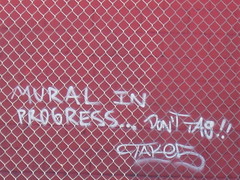
Mural in ProgressMural in progress … do not tag. Taker

This public surface, reserved for Taker, could be a scene in John Burn’ new novel Runnerland

Runnerland is about Peter, aka Runner. He’s an amateur artist. A kid living on the streets. And he’s running from life.

In particular he’s running from his former life, that of typical teenager whose living the middle-class lifestyle. The thing that drives Peter away from home is his father’s death and the discovery that he’s adopted. These two life altering moments result in a bus trip across Canada, the initiation into a street group (kind of a gang but that’s never explicit).

The thing that I like about Peter’s story was that it was believable. Believable enough for someone who doesn’t live on the street and who’s never run away. I like that he doesn’t follow the path of drugs. But he gets messed up in his own way. I feel that Peter is lost, but I also feel like he’s smart enough to survive.

I hope Taker is too.

See more about Runnerland by John Burns.

Book Review: Divisadero by Michael Ondaatje

The English Patient, The Cinnamon Peeler’s Wife and Handwriting are the only Ondaatje books I’ve ever read. I enjoyed them. I like the lyrical nature of Ondaatje’s writing.

Divisadero fits the bill perfectly. Ondaatje is telling two stories, a modern-day love story and a forgotten love story–I suppose both are forgotten in some ways.

The first story is Anna’s. In the 1970s in northern California, Anna lives with her sister and father on a farm. The hired hand, Cooper, is also part of the family. All three children, Anna, her sister and Coop, have lost their mothers. It’s a strange world. The mothering nature is missing. There are unspoken rules. The girls are competitive for affection. It unwinds when Coop and Anna begin a tryst that is discovered by her father. Anna runs away and keeps running from love for the rest of the story.

The second story is Lucien Segura’s. In a much earlier time in south central France, Lucien lives with his mother, and next door lives Marie-Neige. She moves there with her husband, a much older husband. Lucien and Marie-Neige grow close as they grow up. It’s the turn of the century and times are different than in 1970, yet the complications of loving someone forbidden to you are much the same.

Lucien’s story is much stronger than Anna’s. Although I enjoyed the writing of both, Lucien’s story is almost mystical. It’s more suck in my imagination than Anna’s story.

I wonder if all of Ondaatje’s love stories are ones of lost, discord and memory.

Find out more about Divisadero by Michael Ondaatje.

UPDATE: Don mentions in the comments that Random House has a podcast featuring Michael Ondaatje and his M&S editor talking about Divisadero.

Thanks Don.

Book Review: If Minds Had Toes by Lucy Eyre

If Minds Had Toes by Lucy Eyre is about the world of philosophy as seen by a teenage boy.

Ben Wagner is quite happy playing football and frying chips for his summer job at Cod Almighty. Happy enough, that is, until Lila orders a bag of chips and asks him if he thinks the chips taste the same to him as it does to her. How do we really know? How do we know if “salty” means the same to you as it does to me? How do we know what happiness is?

The next thing you know Ben is crawling through the towel closet for regular chats with Lila in the World of Ideas, the land where philosophers go when they die. A land where they just talk and talk and talk about philosophy.

This is the Narnia-meets-Wizard-of-Oz version of Philosophy.

The World of Ideas a rather boring place, which is suddenly seeing excitement due to a bet between Socrates and Wittgenstein. The bet is whether philosophy can (Socrates) or can’t (Wittgenstein) make a person’s life better–a regular bloke, a Joseph Blogg, a Joe Blo’s life better.

Enter Ben through the closet.

If Minds Had Toes … then we would tickle them.

Lucy Eyre does a great job of tickling her readers’ minds.

All the age-old questions are on display: free will, right vs. wrong, ethics, morals … it’s philosophy 101.

I’d say that If Minds Had Toes by Lucy Eyre is a good book for teens, more so than for adults interested in philosophy.

I don’t think it’s pitched that way but at age 15, 16, you do start thinking about free will and the larger universe and whether there is a god or a powerful being, what is right and wrong. Lucy has a way of portraying straight-up philosophy in an entertaining way. So much so that I’ve started to understand why someone could argue that we do not have free will.

My mind has been tickled.

Book Review: The Good Husband of Zebra Drive

The Good Husband of Zebra Drive by Alexandre McCall Smith is book 8 in the No. 1 Ladies’ Detective Agency series.

This is a series I particularly love. The characters are incredibly charming, the adventures and mysteries are secondary to the human-behaviour stories being told, and at the end of a long day I can depend on Mma Ramotswe to give me a good laugh.

These are just fun, well-written books.

Often with a series there is the risk of the author running out of steam or of the plots losing their shine, not so with this series. Thank you Alexandre McCall Smith.

Book Review: The Falconer’s Knot by Mary Hoffman

The Falconer’s Knot by Mary Hoffman is a novel about two teenagers in medieval Italy. One is Chiara, whose brother sells her to a nunnery because he can’t afford to keep her, and the other is Silvano, who is taking refuge is the neighbouring friary. Silvano is accused of murdering a man in a nearby town. The two are unlikely apprentices but soon find solitude in their new lifestyles. The fact that they get to enjoy each other as eye candy every once and a while doesn’t hurt.

Mary Hoffman is one of my favourite writers. She has another series for teens called Stravaganza, which is also set in Italy but during the Renaissance. It’s a trilogy and involves time travel.

I love Hoffman’s books because although the reading level is aimed at teens, the story is better written than many adult novels I read. My perception is that teen writers have to work extra hard to succeed. Their books are a hard sell–imagine trying to grab the attention of a teenager, to find a subject that will be new but not totally foreign, that involves sex but sex that won’t get banned by parent groups and librarians.

The Falconer’s Knot is a mystery. Silvano is taking refuge in the friary while his father tries to find the true murderer, but he is soon pegged as a suspect in a series of suspicious deaths in the friary. His only friend in the friary, the Colour Master, is also under suspicion. Over at the nunnery, Chiara is getting her hair chopped off and sporting the nun’s habit. She is also working with the nuns’ Colour Master.

The Colour Masters are creating pigments used for church frescos. This side story is really interesting because the information about religion and the painting of the frescos in Italy during the Middle Ages is interwoven in a non-intrusive way.

Overall this is a fun book. I’m not adept at figuring out mysteries so I couldn’t guess the ending, but in these types of literary mysteries that’s never really the point. This is just another damn-fine book from Mary Hoffman.

Book Review: The Sunday List of Dreams by Kris Radish

Bringing sexy back.

We had quite the Sunday night. I finished Kris Radish’s book The Sunday List of Dreams, and we saw the movies Perfume and Little Children. All three are thematically linked by stories of sexual repression.

In Perfume the protagonist is killing women in order to capture their scent. In Little Children unfaithful partners are endulging in the sex they don’t get at home and sexual predators are trying to control themselves.

As I say, it was quite the Sunday.

Kris Radish’s book stands well above the movies though.

The Sunday List of Dreams is about Connie, retired nurse, getting on with her list of dreams.

1. Stop being afraid.
2. Let go.
3. Get rid of SHIT. Starting with the garage.

Funny enough it’s the shit in the garage that gets her into shit.

Connie discovers a box of files belonging to her oldest daughter Jessica. Jessica lives in New York and is a very busy CEO of a manufacturing company. Connie lives in the Mid-West. Her other two daughters are happily married with children. But Jessica has gone astray. They don’t talk as much as Connie would like.

Well it turns out the box of files contains early business plans and sketches for Jessica’s company. She sells sex toys.

That’s enough to jump start Connie. She on a plane to New York to find out what the hell Jessica is up to. Mother madness. Full panic. Rescue Jessica.

There is a very funny oh-my-god moment (for both mother and daughter) as Connie enters Jessica’s store for the first time.

Nothing like seeing your mother surrounded by dildos. Nothing like visiting your daughter’s sex shop for the first time.

Things, of course, fall apart and come together, and despite very few plot surprises, The Sunday List of Dreams is a good romp.

One of my favourite lines in the book:
Quote: Look at yourself. Not your face, sweetie, your self … If you are giving driving directions to someone else it really helps to know the map.
—The Sunday List of Dreams by Kris Radish

Book Review: iGeneration by Jason Logan

iGeneration is by Jason Logan, the illustrator who brought us If We Ever Break Up, This Is My Book.

iGeneration: Shuffling toward the Future is a quirky little book about technology and its control over our lives.

The whole book is illustrated, in fact, it’s very light on text. But it is pretty cute.

One of my favourite pages is “What the hell am I supposed to do whilst my music is downloading?” One suggestion is to create a false cache history to disturb your parents. For example,

panda-child-acid.xxx
makeabomboutofcommonhouseholdproducts.com
freeoldmansex.nz.org
prisons+welfare+lifeplan.com
make_some_cash_while_in_prison.com

I’d post a video review when I get a chance. The book is funny enough that you should have a look at it.

Book Review: Rock ‘n’ Roll by Tom Stoppard

Arcadia by Tom Stoppard is one of my favourite plays, in part because I had to study the hell out of it in unversity and in part because it is one of the first dates that James and I had.

I was excited to see Stoppard’s new play Rock ‘n’ Roll is now published. Rock ‘n’ Roll premiered at the Royal Court Theatre in London, in June 2006.

The cover is a very striking yellow, and the edition that I have includes an introduction from Stoppard. I find the author introductions to plays most fascinating. When I was in school I hated reading any of the extra bits, but now I’m much more interested in the context for the story, what references the author is trying to make, what he or she hopes the reader gets out of the text. The introduction to Rock ‘n’ Roll doesn’t disappoint, and it is a good recap of what was going on in Prague and Cambridge from 1968 to 1990, more directly what effect the Communist regime was having on musicians, philosophers and students.

In case you don’t know Tom Stoppard, he was born in Czechoslovakia in 1937 and moved to England as a child in 1946.

Quote: The Amazon copy says:
Catapulted into the front ranks of modern playwrights overnight when Rosencrantz and Guildenstern Are Dead opened in London in 1967, he has become recognized as a contemporary comic master, the brilliantly acclaimed author of The Real Inspector Hound, Enter a Free Man, Albert’s Bridge, After Magritte, Travesties, Dirty Linen, Jumpers, New-Found-Land, Night and Day, The Real Thing, Hapgood, Artist Descending a Staircase, Every Good Boy Deserves Favor, Arcadia, The Invention of Love, The Coast of Utopia (Voyage, Shipwreck, and Salvage), and Rock ‘n’ Roll. He has also written a number of screenplays, including The Romantic Englishwoman, Despair, and Brazil.

Rock ‘n’ Roll highlights the moments of friendship and tension between Jan and Max. Jan is a lecturer at Cambridge who returns to Prague just as the Soviet tanks are rolling into the city. He’s a music fan and in addition to a brief history of Czechoslovakia, you get a brief history of The Velvet Underground, Pink Floyd, Syd Barrett, The Rolling Stones, The Beatles, Lennon, Andy Warhol, and Frank Zappa. Max is a Marxist philosopher with a free-spirited daughter and a Sapphic philosopher wife who is dying from cancer. Over a 20-year period Rock ‘n’ Roll offers little windows into Jan and Max’s acceptance and resistance to the Communist regime.

The remarkable thing about the play is that it’s heavy in a light way. There’s a sense of bouyancy and humour. In many ways it reminds me of Chekov’s plays, but without the dark, foreboding sense that, as James says, “it’s a godless world and we’re all going to die.”

Rock ‘n’ Roll–a new play by Tom Stoppard–read more on Amazon.ca
Book Review: The Nature of Monsters by Clare Clark

Clare Clark is the author of two very fine novels, both of which deal with elements of the underground and unsavoury human behaviour. Her first novel The Great Stink is set in Victorian England, more specifically in the labyrinthine London sewer system. Hence the great stink. But Clare’s writing far from stinks, it is tight and interesting.

Yes, The Great Stink is a historical novel, but not one with a familiar setting. The Great Stink deals with a sewer engineer, William May, and the solstice his finds in cutting himself in the solitude of the sewers. That is until a murder is committed in the underground and he is implicated.

See what I mean? Underground and unsavoury.

Don’t be dismayed by the setting though, the details of the sewer structures, their repairs and the times of Victorian England are in perfect harmony with the strange and complex story of William May.

Not only do I highly recommend The Great Stink, I’m a fan of Clare’s latest novel, The Nature of Monsters.

In 1718, pregnant Eliza Tally is packed off to London. She is to work as a maid for apothecary Grayson Black, have the child or get rid of it, and do so while protecting the perception of her own virtue and the good name of the father of the child. What transpires instead is a tragic and twisted tale of scientific experimentation on mothers and unborn children. Eliza and a second maid, Mary, are psychologically tortured by the apothecary and his wife in hopes that they will bear monsters instead of healthy babies.

Eighteenth-century England is a time of deep interest in science, medicine and literature, but it is also a time of home remedies and superstitions. A pregnant woman caught in a fire can expect her child to be born with a red birthmark. If a hare runs across a pregnant woman’s path she can expect the child to be marked by the animal–perhaps it was a hare that created half-moon Mary.

Half-there or not, Mary charms Eliza, who discovers the apothecary’s goal and is driven to save Mary. It is too late for her own child.

Both novels are visceral. There is the putrid smell of the sewers in The Great Stink, the descriptions of cutting and the horrors of murder. In The Nature of Monsters it is the monsters of the novel–Grayson Black, his wife and the apothecary’s assistant, along with Eliza’s lover and her mother–who act as monsters. Betrayal and sacrifice for science are the elements of horror here.

Most horrifying to the reader are the descriptions of leeching, bleeding and opium use, which are counter to our modern-day understanding of medicine. We have 250 more years of discovery under our belt, and yet it is the many scientists of this time whose experiments inform today’s understanding of the mind and body. So it is the readers’ good fortune to have such an adept storyteller and historian weaving the tale of Eliza and Mary with the medical curiosities of the day.

I am a fan of Clare Clark. Both novels are great and I truly think readers of The Great Stink should seek out The Nature of Monsters and vice versa. My only caveat for newbies to Clare’s work is to be prepared for the world she transports you to, it is inevitably underground and unsavoury, in the best of ways.

« Older posts Newer posts »

© 2026 So Misguided

Theme by Anders Noren — Up ↑