Soucouyant is a novel about memory by Vancouver author David Chariandy. Soucouyant is Chariandy’s first novel, but I suspect that it’s his first published novel. I imagine he has a trunk full of manuscripts and journals chock full of notations about characters.
Soucouyant was shortlisted for the 2007 Governor General”s Literary Award and longlisted for the 2007 Scotiabank Giller Prize. Award nominations don’t normally impress me but to have two nominations for the top Canadian prizes and to be a first-time author–that’s impressive.
There’s good reason for the nominations. The novel is a twisting plot of memory fragments. Adele is suffering from dementia, she is near the end of her life and her son has returned home to care for her. The fragments of memory that tell the story are those of Adele’s childhood in Trinidad during the Second World War, of the son’s childhood in Ontario, in a house near the Scarborough Bluffs, and of both characters’ present day experiences.
The memories that comprise the whole are about discord, displacement and distance. The discord appears in stories of racism and classism that the characters suffer. The displacement is the us vs. them, the plight of immigrants, the settling in that never quite happens for this family. And the distance is that which they create between themselves. The mother’s dementia distances her mentally from the present, the father dies, which pulls the family slightly apart, the oldest son leaves home to become a poet, the youngest also flees but later returns, only to distance himself again by being emotionally guarded.
Quill and Quire did not give the book a great review, although the reviewer Dory Cerny certainly agreed that it was worth reading.
The Tyee does a much better job of getting in touch with the plotlines Chariandy is experimenting with. I highly recommend checking out what The Tyee has to say on this one. It’s a great interview with David Chariandy.
And, I thought the book was great. It would be an interesting book club pick because the writing is strong and the story provides ample topics to discuss. It reminded me a little bit of At the Full and Change of the Moon by Dionne Brand.
I like to review a book after I’ve read it. I hope that’s a standard course of action for most reviewers. The problem is that I have a full-time job, which means that you are left to the whims of my schedule and reading habits, and this particular book cannot be washed away or soaked too long.
As a cautionary sort with germs, I’ve often reflected on the origins of my cleanliness. It’s the fault of my mother and uncle. As a school kid, I came home for lunch. My mother, like all good mothers, would tell me to wash my hands. I’d run upstairs, turn the tap on, play with my hair, turn the tap off and run downstairs for my lunch. Notice there was no hand washing.
My uncle was a regular lunchtime guest. He was studying science at the university and one day brought along some books for me inspect. Science books. Science books, full of microscope photos of germs. Germs on your hands. Germs in your snot. Germs on school tables and door knobs.
I was a princessy girly-girl. I barely liked fuzzy caterpillars.
From then on I scoured my hands raw.
Did I mention that I was a child of extremes?
Katherine Ashenburg can relate to my experience. In the introduction of The Dirt on Clean, she talks about standards of hygiene reaching absurd levels in the late 50s and early 60s.
Quote: The idea of a body ready to betray me at any turn filled the magazine ads I pored over in Seventeen and in Mademoiselle … A long-running series of cartoon-style ads for Kotex sanitary napkins alerted me to the impressive horrors of menstrual blood, which apparently could announce its presence to an entire high school.
Oh, the hysteria. Imagine smelling offensive and not even knowing!
The Dirt on Clean is a history of cleanliness from a Western perspective, and what I like is Katherine’s writing style. She’s chatty yet thorough, gossipy yet respectful. She shares, for example, without naming names, some of the stories people confess about their own overly enthusiastic cleaning rituals or, more frequently, their avoidance of soap and water.
In the closing paragraph of the introduction, Katherine refers to Benjamin Franklin, who said that to understand the people of a country, he needed only to visit its graveyards.
Katherine says, “show me a people’s bathhouses and bathrooms, and I will show you what they desire, what they ignore, sometimes what they fear–and a significant part of who they are.”
So what smell are you? Mango, vanilla, smoke and sweat?
What would Katherine find in your bathroom that would betray your true colours (or smells).
I was looking for a Dan Brown-esque novel to read while in Malta–you know, a light read on goddess worship–and I found this in a bookstore in Valletta, The Maltese Goddess by Lyn Hamilton.
I was looking for a goddess worship book so that I could remind myself of some minor historical points that were alluding me, and so that I could think more about goddess worship on Malta, which seems to have been a big deal. Malta is home to the oldest freestanding structures in the world. The temples of Malta are over 5,000 years old, much older than the pyramids and Stonehenge. And the big find has been thousands of female statues.
The Maltese Goddess was an ok read. It’s labeled an archaeological mystery but really it’s a mystery set on an archaeological site–at one of the temples. The book is set initially in Toronto, where the heroine has an antique shop. Martin Galea comes in, “Mr. I’m So Wealthy I Can Fly You to My Home in Malta to Decorate.” That’s all cool and dandy until Mr. Galea turns up in Malta dead as dead is and stuffed into a dresser.
As I say, it’s light on the goddess worship but was a fun find nonetheless.
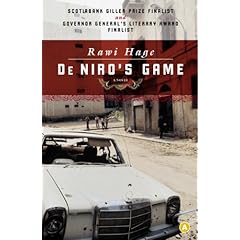
A couple of years ago I was in Calgary at the Writers Festival, and I had the good fortune of meeting Rawi Hage in the Author’s Lounge.
I was inspired to hear his talk on a panel about “writers writing from away”. Since then I’ve wanted to read De Niro’s Game, but for some reason it’s taken me until now to do so.
De Niro’s Game is set in Beirut during the Lebanese civil war in the 1970s and 80s. De Niro is actually George, who is friends with Bassam, our narrator.
George and Bassam are just kids when the war breaks out. They hunt around for bullet casings, which they trade with neighbourhood kids. George and Bassam grow up to be thugs, the kind of thugs that develop because of civil war. George, I think goes a bit further than Bassam, joining the militia, doing cocaine, experimenting with–who knows what. Bassam is more silent. Perhaps he is just as bad but since he’s the narrator we don’t know about it.
De Niro’s Game by Rawi Hage is the story of George and Bassam and their escapes from the war. For Bassam, it means being smuggled out of the country to France. His escape and time in Paris forms the last third of the book, which I felt was the strongest writing in the novel.
A talented author, Rawi Hage is dynamite at conveying the complexities of his narrator’s character and the betrayals of war. The earlier part of the novel though was riddled with adjectives, annoyingly so:
Quote: Ten thousand bombs had landed on Beirut, that crowded city, and I was lying on a blue sofa covered with white sheets to protect it from dust and dirty feet.
Either the adjectives decreased throughout the story or my patience with them increased. Regardless, I did enjoy this tale of one man’s struggle with identity, war, friendships, betrayals and growing up.
Australian author Danielle Wood has created a series of interconnected anecdotes about the lives of women: naughty ones and nice ones. Rosie Little is our connecting character, sometimes a character in the story, sometimes just a narrator.
Wood certainly has an eye for detail and an ear for dialogue. The moments portrayed are pitch perfect. There is a story about a bride in full wedding dress, stuck in an airport during the wee hours of the morning when nothing is open, which cracked me up. There is a story about a nurse for chronic-care patients who is secretly buying baby clothes and storing them in a suitcase under her bed, which made me very sad. Each story struck a chord. And the opening story about fellacio is damn funny.
The packaging of the book is definitely worth mentioning. This is a sturdy little hardcover book. It is super attractive.
Turpentine by Spring Warren is a Western set in the 1870s. Edward Turrentine Bayard III (“Turpentine”) is our tragic hero. He’s a coward and thinks himself otherwise. He’s misguided and thinks himself enlightened with manners and fortune. This is a cyclical story. Turpentine’s fortunes rise and fall depending upon his decisions, and unfortunately for Turp, he can be a bit of a twerp.
Although Turpentine is tragic, the novel is not. Spring Warren is a fine storyteller and she paints a Wild West worth visiting.
The story is this: Turpentine is sent on a train west by his doctor. He is to attend a sanatorium and improve the health of his lungs. He ends up in the Wild West skinning buffalo and courting girls. Turpentine, being of better means earlier in life, is an artist. His sketches catch the attention of a Peabody Museum scholar who is studying fossils. Turpentine is invited to the Peabody as an assistant. It seems his life is about to change, and yet this is just one of the many ups soon to be followed by a down.
A couple of weeks ago I received a lovely email from Don Bailey, who is publishing his third novel, The Good Lie, with Turnstone Press, the same company that published James’ book Up in Ontario.
Don asked if I’d mention his book. I normally don’t feature a book until I’ve had a chance to read it, but there are certain books that come to my attention that I do want to share. In this case, Don Bailey. Why? Because Don Bailey sent me a nice note complementing SoMisguided and its support of Canadian publishing, because his book is edited by Wayne Tefs, who is another author I love (check out his novel Red Rock) and who played hockey with James in Winnipeg and also who edited Up in Ontario, and because Don has created a website for The Good Lie that tells some stories about the story of The Good Lie, and I enjoyed reading the behind-the-scene stories.
All good things, I think.
So I’m going to check out the novel, and if you have a chance to before me, let me know what you think.
Also I heard that Turnstone Press published Todd Babiak’s first novel, which is another reason to support Canadian publishing.
So I’m sorry if I’m light on witty commentary, I’m trying to blast out the door to Malta, but I did not want to leave without mentioning The Good Lie.
Earlier this month I had a chance to speak with Sabine Milz. Sabine is a Postdoctoral Fellow, funded by the Social Sciences and Humanities Research Council and affiliated with the Department of English and Film Studies at the University of Alberta. She is currently doing research on the current state of the book industries of the prairie provinces: Alberta, Saskatchewan, and Manitoba. As part of this research project, she’s conducting interviews with people at the front lines of the publishing industry.
With permission from Sabine, here’s our interview:
Sabine Milz (S.M.): As an expert in online marketing and communities and a blogger on the publishing industry in Canada, how would you describe the relations between the former (online marketing and community-building tools) and the latter (Canadian publishers, distributors, writers, booksellers)? One of my interviewees noted that she thinks the publishing industry in Canada, and in North America more generally, has been very slow to figure out how the Internet is going to change people’s habits, both in terms of reading and buying.
Monique Trottier (M.T.): I agree with your other interviewee. The Canadian publishing industry has been rather slow to adopt online marketing strategies. I launched the Raincoast blog in Oct 2005 and the podcast series in November 2005. At the time, Raincoast was the first Canadian publisher to start podcasting. There were very few publishers internationally who were also on board, Penguin UK being by far the most advanced–and the program style that we used as a base for the Raincoast program.
In the last 2 years there have been federal and provincial grants made available to publishers who wish to experiment with digital means. In some cases this has meant online marketing programs and in other cases it’s meant the digitization of their backlist and the search for ways to sell digital copies.
There is definitely an explosion going on in the publishing industry. It’s like everyone has woken up and finally believes that the internet revolution is here.
That relationship between the publishing industry and their adoption of web 2.0 and online tools can be best described as cautious.
What is also of interest is the lack of experimentation at the book retail level. The late 1990s was a period of rapid growth for Amazon.com and the online retail sector in general. In North America, several bookstores launched ecommerce sites:
In many ways the only retailer that moved forward in adopting web 2.0 strategies is Amazon. Chapters/Indigo is now playing catch up. McNally Robinson has attempted to move in this direction, although there are a lot of things I hate about their new website. Sadly, the publishers are now taking over marketing online, but the online sales support is not there on the retail side.
S.M.: In the overview of your BPAA [Book Publishers Association of Alberta] Conference talk, it says, “Online marketing is more than electronic press releases and creating a website. It’s about engagement and conversation.” With the signal to noise ration very high on the Internet and the existence of an overwhelming multitude of blogs and zines dedicated to literature, how can publishers and writers still create this engagement and conversation?
M.T.: Signal to noise is really high. In order to succeed publishers need to focus on campaigns that are engaging and relevant to their target audience. I argue that online marketing is not about one-off promotions or press releases but rather need to be part of a comprehensive business strategy. An electronic press release is only good if it drives people to a webpage specific to that press release. That webpage has to then continue the conversational thread of the press release. There need to be calls to action that are clear, a memorable marketing message that is also “branded” or used in print materials at the store level, in magazine and newspaper ads, etc. The web is another sales channel, but it does not act independent of publishers’ other marketing activities.
In order to stand out, publishers’ online marketing campaigns need to be about finding their target audience or their online community and participating in that community according to the rules of that community. They have to use a conversation voice, not a spammy marketing voice. They need to participate in the community, they can’t come and go only when they have a marketing message.
It’s about investing time in their online community, the same way that publishers sponsor literary events or do community out reach in person.
S.M.: What can a personal blog or participating in blogs do for a publisher/writer?
M.T.: It can increase awareness of the publisher or writer. Blogs are networked communities. They represent a return to “marketplace”. Marketplaces used to be physical places where people gathered. It was a social square, a marketplace, it was about shared voices, shared news and gossip, shared interests. At some point it became “marketing”. A thing that happens to people. You are marketed to. It’s against your will, it’s about consumption. It’s one-way communication–a company tells the masses what to buy or think about a product or service. The online revolution is a return to marketplace. On the web, people gather in networked communities to talk about shared interests, to share news. It’s voluntary. It’s a conversation. We are creating our own ads, reviews, videos. We have publishing tools. We are loudly voicing our opinions. And we are saying to companies, “you can be a part of this conversation or not, but if you choose not, the conversation is going to go on with out you.” [This is David Weinberger, http://cluetrain.com ]
S.M.: Is online marketing about targeting special interest groups/readers rather than general audiences/readers?
M.T.: Chris Anderson talks about this in The Long Tail. Yes, we are moving away from targeting mass audiences and putting our focus on bestsellers. Although we are going to use a mass media tool (the internet) to connect to targeted groups, to sell niche titles.
S.M.: Several of the people I have interviewed so far predict that the future of traditional literary publishing will lie in the publication of affordable print book artifacts, of beautiful print books designed as artifacts. What is your sense of the future of traditional publishing?
M.T.: The form of the product is going to be dictated by the desired use. For example, I have a PDA and I like to hike. I don’t want to take a guide book with me. Paper is heavy. I want to load everything into my PDA, which also has a GPS.
I am an editor. I will never buy a physical copy of The Chicago Manual of Style because the online version has everything and it is searchable. I don’t read Chicago, I use the index of the physical book and then look up a particular section. The online version mimics my behaviour. I need to search and browse. This experience is much better online.
I am a fiction lover. I want to read in bed, curled in awkward positions. I do not want to hold an ebook reader, PDA or laptop. In the bath, I definitely do not want an electronic device.
But I sometimes need to read a novel for a class. It’s not a book I would seek out or care to own otherwise. I want a digital copy that I can read on a screen and make notes about.
Publishers have to stop focusing on the format and start focusing on how to provide all formats, how to meet their audiences’ needs, and how to build into their contracts with authors the ability to provide these various formats.
It used to be that publishing a hard cover was a luxury. It was something special to be published in hard cover. It make become that publishing a physical book is a luxury. That all books are published electronically and that we publish a physical book when the market demands it.
S.M.: What are the key transmutations or changes the book — and especially the poetry and fiction book — as object has gone through as a result of new technological developments? Who, do you think, is at the front lines of this process of transmutation or change?
M.T.: Technology has changed every aspect of the publishing industry. We’ve gone in 20 years from printing plates to digital printing, from handselling and paper forms to exchanging bibliographic data in the supply chain using isbns and standard data formats. We have FedEx tracking numbers, standardized subject codes, credit cards, databases.
I’m not really sure what you’re asking here, but, taking stab, the entire process for creating the physical product has changed, and all of those changes are what has prepared us for the digital distribution of content.
S.M.: I want to put forth for your feedback another idea regarding the future of traditional publishing: Considering the way technological developments have changed the recreational habits of people, could publishers gain from redefining themselves in non-books-related terms, that is, as cultural producers who take an intellectual creation and turn it into a cultural artifact (which may not necessarily take a traditional book form but, for instance, a podcast or an e-book with multimedia links or a video), which is then distributed to its logical public? Do publishers of the future need to define themselves not by the cultural product, i.e., as book publishers, but by the process of delivering intellectual creation to an audience?
M.T.: I don’t believe in the death of the book. I think when and if it happens, it will happen because we have run out of trees and the means to make paper. Think about the history of the technology we call paper. It’s a rather useful piece of technology. Book publishers can define and redefine themselves until they are silly. What does it matter, who does it matter to? We understand the role of the publisher is to act as a filter, a gatekeeper. The publisher is a subject-matter expert. One who understands publishable works, quality writing, writing that should be made available to the public. That role is still a valuable role. In that signal to noise ratio, which we talked about, this is a fantastic role to play. The discerning voice of the publisher, one who makes works available to other. In this mode, anyone can act as publisher. I can self-publish. My role is still the same. To take some thing that I see as having value and making it available to others who will perceive its value and be willing to acquire it–in whatever form makes sense for their intended use.
Publisher has a different connotation than Content Producer.
S.M.: This questions has been inspired by my hearing and discussing a definition Karl Siegler gave to an interviewee. Siegler said that a publisher is someone “who takes an intellectual property, turns it into a cultural artifact, which is then distributed to a logical public.” I think that this may tie in with your above statement that “Publishers have to stop focusing on the format and start focusing on how to provide all formats, how to meet their audiences’ needs,” in the sense that it is about the “delivery platform” (term the interviewee used) as multiple platform. Publishing then seems to become more of a multimedia activity, an activity that breaks down traditional media separation in its attempt to meet the needs of diverse audiences.
M.T.: Yes, I agree with Karl.
S.M.: Do you see a danger in publishers/writers/artists using web space aggregated, organized, and dominated by an oligopoly of 21st century information-technology giants: iTunes, Amazon, Netflix, eBay, Yahoo, Google, MySpace? Using and thus supporting these oligopolic structures, doesn’t literary activity and artistic activity more generally contribute towards the centralization and potential regulation of knowledge distribution and artistic activity?
M.T.: No, I do not see a danger.
These oligopolic structures do not exist without us. The sites you list above represent our shift in attitude towards the web. We are always connected, always on. Those sites only succeed because of the network of people participating in those communities.
If you want to view the global community (the world wide web) as an evil empire than your other choice is obscurity.
Not a danger, but yes, it means we need to rethink things like copyright, control, ownership, distribution and commerce.
End of Interview
=============
So comments? Follow up? Where are the publishers in the crowd? How do you see your role changing?
UPDATE: When I posted about this the widget would take you to the HarperCollins book detail page. From that page there was a link to BookBrowse. Those links no longer appear on the website. I’m not sure why. So the coolest feature ever appears to be disabled 🙁
Craig Miller of LibreDigital is here presenting on online marketing technology and he is showing an example of a widget that they’ve created for publishers who are storing their digital assets with LibreDigital.
And, LibreDigital is super cool. If I could use this type of widget for all the books I review, I would be a very happy reader and reviewer.
Why because I can tell you how good the book is, but it’s my subjective opinion. It would be great if I could give you a link to look inside yourself.
Every Labour Day Weekend since 1977, writers have gathered to sweat, cry and produce amazing 3-day novels. This “trial by deadline” is going on right now. www.3daynovel.com
But I have other things to do this weekend, like making peach pie, so instead of whipping off a novel, I’m reading The Convictions of Leonard McKinley by Brendan McLeod, a recently published winner of the 3-Day Novel Contest.
McLeod’s protagonist Leonard is a crazy piece of work. I imagine he was born amidst too much caffeine and too little sleep.
In some ways The Convictions of Leonard McKinley is a morality play. Wikipedia defines this as “a type of theatrical allegory in which the protagonist is met by personifications of various moral attributes who try to prompt him to choose a godly life over one of evil.”
For Leonard the morally bad take the form of round-bottomed cute girls, his desires to achieve NBA fame, and his increasing interest in deviance.
There is certainly a secular nature to Leonard’s desires that conflict with his visions of martyrdom. He promises God that if he performs well at basketball try-outs that he’ll open up an adoption agency when he’s older.
But what starts as innocent questioning of God and morals in the 6-year-old Leonard, even in the teenaged Leonard, gives way to a form of religious fanatisism that cripples him.
The Convictions of Leonard McKinley could be renamed The Ethical Trials of Leonard McKinley. As a child Leonard executes ethical trials for himself: if he is good, his father won’t have another heart attack. As a teen he believes that saying the Lords Prayer and volunteering at the Red Cross will ensure his mother’s safe return home from late nights at the office. But as Leonard enters university his convictions that well being is a reward or punishment determined by God lead to darker thoughts about homosexual yearnings and pedophilia. He creates trials for himself that were funny child-like behaviour earlier but are now disturbing.
Leonard is pretty creepy but the novel is good.
I agree with the quote by author Terence Young, “Brendan McLeod presents us with a protagonist who is at once mesmerizing and ridiculous, charming and offensive … He draws our attention like a really good house fire.”
And with kind permission from 3-Day Books, here is a short excerpt:
PART ONE
When Leonard turns six, his father buys him a bike without training wheels because he wants to learn to ride like he is escaping from assassins with lasers. Leonard’s father shuffles him up and down the street, breathing hard at his side until he sustains heart palpitations and Leonard takes off on his own. He flies around the suburban streets of Calgary until he can no longer see his house and has to stop at a store for directions.
“I can’t tell you unless you buy something,” says the clerk. Leonard has no money, so he kicks down the newsstand outside and rides away crying. Two hours later a policeman finds him sulking against a tree and puts his bike into the backseat. He drives Leonard halfway home, but pulls a U-turn after hearing the whole story. They return to the convenience store and the policeman disappears inside for ten minutes. When he comes back out Leonard asks him what happened.
“I gave the bad man a ticket,” says the officer.
“What for?”
“Being a dick.”
“Awesome,” says Leonard.
The policeman pulls away. “Did you kick down his newsstand?”
“Yes.”
“Good.”
When the policeman pulls up in front of Leonard’s house his father is being wheeled away on a gurney. The large lights of an ambulance reflect off the gleam of the neighbours’ gaping mouths behind their windows. Leonard’s older brother Steve is standing on the walkway, his hands over his lips as though afraid something will escape from him.
Leonard’s younger brother Nick is wandering around outside wearing his costume from his fourth birthday party last week. Their mother had allowed him to dress up as the sheriff, so he locked his friend Pete in the laundry room after he hadn’t given him a present that involved the California Raisins.
Now, Nick moseys up to the police car. Leonard and the officer quickly get out.
“You killed Dad!” Nick shouts at Leonard. Then he shoots the police officer full of imaginary bullets and dives behind a bush.
“Shut up, Nick!” Steve yells.
Their mother runs up to Leonard and holds him tight to her waist. Then she smacks him on the bum for going missing and kisses his forehead to assure him their father is going to be okay.
Mrs. Shelbourne from next door comes over to look after them while their mother follows the ambulance to the hospital. They eat dinner in silence. Steve, who is in grade six, won’t talk to Leonard because he is just a stupid little kid who still gets lost. Nick won’t speak to Mrs. Shelbourne because she beat him at Hungry Hungry Hippos, except to briefly accuse her of cheating. Mrs. Shelbourne threatens to send him to his room for being impertinent, so Nick says he was just worried about their dad in the hopes that she’ll feel sorry for him and give him a cookie. She doesn’t fall for it and Nick refuses to eat his peas in protest.
Brendan McLeod is a writer, musican, spoken word artist, former Canadian SLAM poetry champion, and previous winner of the 3-Day Novel Contest.
www.brendanmcleod.ca
 Soucouyant is a novel about memory by Vancouver author David Chariandy. Soucouyant is Chariandy’s first novel, but I suspect that it’s his first published novel. I imagine he has a trunk full of manuscripts and journals chock full of notations about characters.
  Quill and Quire did not give the book a great review, although the reviewer Dory Cerny certainly agreed that it was worth reading.
  Canadian author.

 Australian author Danielle Wood has created a series of interconnected anecdotes about the lives of women: naughty ones and nice ones. Rosie Little is our connecting character, sometimes a character in the story, sometimes just a narrator.
  Turpentine by Spring Warren