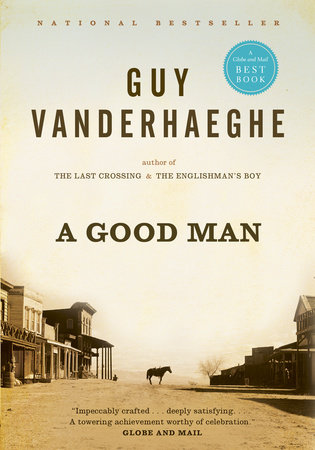
A Good Man is a solid Canadian western set in the late 1870s in the Canadian and American West, specifically around the border between present-day Montana and BC, Alberta, Saskatchewan. Not only is this an amazing western, but it’s also a political, historical novel about nationhood.
This period of time was full of crazy upheaval and the novel explores the political tensions as well as the personal dynamics between a few key characters.
Wesley Case, our main protagonist, is a former solider and the son of a Canadian lumber baron. Case leaves the North-West Mounted Police and, defying his father’s request to enter politics, settles in the American West as a cattle rancher. Case acts as a liaison between his former Canadian boss Major Walsh and the American counterpart Major Ilges. There are several unresolved conflicts between the Sioux and the Americans, the Fenians are still looking for independence from the British and making trouble in Canada, the American Civil War has technically ended in 1865 but there’s the general anxiety that the Americans now can turn their attention to Canada, plus there’s the commonplace violence between settlers staking claims and stealing claims. It’s a time of alliance building amidst mistrust.
Within the personal stories, we have similar tensions and alliances, especially love triangles, friendship triangles, and collegial triangles. The most satisfying being that between Mrs. Ada Tarr, Wesley Case and Joe McMullen. Case and McMullen met in the police and Case convinced McMullen to join him in starting the ranch. Case was the money man and McMullen had the needed skills and experience. They have the strong friendship of frontier men who sweat side by side during the day and get under each other’s skin at night. Mrs. Ada Tarr is the object of their affections, although it’s clear Case’s are romantic and McMullen’s are platonic. They are a dynamite trio.
Contrary to that is the triangle of Ada, Case and Michael Dunne. Dunne is a hired hitman, initially working for Ada’s husband, lawyer Randolph Tarr. (There’s another set of trios: Randolph, Ada, Dunne and Randolph, Dunne and Gobbler Johnson.) Tarr has failed to properly help Gobbler Johnson win a property claim and Gobbler has taken to giving Tarr death threats. Tarr hires Dunne to take care of it. In the duration of that contract, Dunne falls for Ada’s kindness, which he misinterprets as love interest on her part. So when Tarr dies, Dunne thinks Ada is now free to love him. It more than raises Dunne’s ire to learn that Case has swooped in on his beloved.
The plot is slow in unfolding, but it’s against the backdrop of the complex and slowly unfolding political tribulations Case, Walsh, and Ilges are observing between their governments and the various Indigenous communities being displaced from their traditional territories, starved, and shipped off to unfavourable reservations. The other triangle is Case, Walsh and Sitting Bull.
After defeating Colonel Custer at the Battle of Little Bighorn in 1876, Sitting Bull and the Hunkpapa Lakota crossed into Canada to escape the US forces hunting them down. The Canadian government was in a tricky position of not wanting to disrespect their stronger neighbour to the south but wanting to appear neutral. Major Walsh, at least in the novel, is quite sympathetic to Sitting Bull’s plight and does his utmost to feed and provide ammunition to the Indigenous people seeking safe harbour within Canadian borders (and, uh, on their own damn land anyway). But Walsh is ultimately forced to bend to his own government’s pressure to push Sitting Bull and his people back across the border to the US.
Yes, the book is a slow read but, my goodness, the skilled writing is worth it. If you like Cormac McCarthy, Jack Keroauc, or Kazuo Ishiguro, then you’ll love the intense style, bleak themes, and poetic prose of A Good Man.
Also, from a modern-day perspective, I don’t think many Canadians understand their history. Here are a couple of lowlight moments.
The American Civil War was fought from 1861-1865. The British Empire, including Canada, had been officially neutral in the American Civil War, but many in government aligned with the South. A “United” States was a more powerful neighbour than many wanted. [Micheal Dunne enters the story here as an everyman for a powerful Canadian who’s on the side of the Confederates.]
So Canada was a neutral but active base for Confederate spies, plots against political figures, and supply operations. We were trying to play both sides, in an attempt to reinforce Canadian independence and nationhood. Remember Canadian Confederation only happened in 1867, as a measure of collective security. The US had several policies aimed at pressuring Canada into political union with the US (sound familiar?). [Case’s early days as a solider highlight these tensions well; and set up a nice piece of blackmail that makes its way into Dunne’s hands later in the novel.]
Following the Civil War, the US continued to have armed conflicts between Indigenous warriors trying to defend their homelands and US forces pushing them off to make way for farming and industrial progress, mining, and the general stripping of resources in the name of settlement. [Case moves from eastern Canada to the wild west and we pick up the political story from there.]
Canada was doing the same. The Northwest Mounted Police formed in 1873 and was created to assert sovereignty and bring “law” to the western territories. They were a military-style force, crucial in policing settlers and aiding (strong-arming) treaty negotiations. We starved Indigenous communities into submission then introduced the Indian Act of 1876 as way to relieve Indigenous people of their self governance. [Walsh is hard-nosed and driven by passion. His allegiance to the British crown is in conflict with his personal alliance with Sitting Bull and this makes for an interesting third-act of the novel, especially as Case tries to act as an advisor to Walsh.]
Territorial dominance was a big deal.
The British Empire was also the hated enemy of the Fenian Brotherhood, an Irish-nationalist society, based in the US, that aimed to achieve Ireland’s independence from Britain by capturing Canadian territory and using it as leverage. There were a series of Fenian scares, armed incursions or raids into British North American during the time of this novel. In today’s secular society, it’s easy to forget that, predominantly Catholic, Irish people in Canada faced a hostile reception from the ruling class of British Protestants. [The anti-Catholic sentiment is subtly noted in the novel with a nod to the Orange Order, but the prejudice against the working class, and low-paid labour force, is clear throughout.]
So alliances, strong-arm tactics, and spying is at the heart of both the political and personal stories in A Good Man. The grit and historical depth of the times are presented in the frontier/violent landscape of the novel, making it an unforgettable story and deeply deserving of its accolades.
A Good Man is the last book in what critics call the frontier trilogy: The Englishman’s Boy (1996, Winner of the Governor General’s Award), The Last Crossing (2002, a CanadaReads winner), A Good Man (2011, a Globe and Mail Best Book).
Now, if you were forced to read The Englishman’s Boy in school, then you may, like me, have avoided reading any more Vanderhaeghe. But this book is so much better. Again, it’s slow. But it’s masterful. I picked it up because of the opening:
Thoughts of Mother early this evening. She came back to me complete, the memory like a fist slammed to the heart. Father always called her “the dragon without scales” to diminish her, but he was like the wolf blowing on the brick house of the third little pig. She did not tumble or collapse under his scorn, not once.
Happy reading.