The Double Life of Benson Yu by Kevin Chong is a layered and thought-provoking novel that blends reality and imagination, fiction and autobiography. The story follows Benson Yu, a comic book artist who is grappling with the trauma of his past. As he begins to write a more serious autobiographical work, the lines between his life and his comic book creations start to blur. The narrative toggles between Benson’s present-day struggles and the fictionalized account of his younger self, which reveals painful truths he’s tried to bury.
The novel explores themes of identity, memory, and the ways in which we try to rewrite our own stories. I recently saw Kevin Chong present at the Sechelt Festival of Writers and he described it as a story about storytelling. And that’s 100% true. The novel is about how the past can haunt the present and the cathartic power of storytelling.
Chong’s writing is vivid yet introspective. The chapters focus on different perspectives and that forces the reader to question the boundaries between author and character, reality and fiction.
If you enjoy novels that challenge narrative conventions and explore complex emotional landscapes, The Double Life of Benson Yu is a compelling read. It’s reminiscent of works like Paul Auster’s The New York Trilogy or Kazuo Ishiguro’s The Unconsoled in its blending of the real and the surreal.
I really enjoyed listening to the audiobook but given the complexity of the story narration, it may have been a better read vs. listen. But Eric Yang is a great reader so the audiobook offered a lot too. It was also fun to hear author Kevin Chong talk about his writing process and how the ideas for this book came together. He’s not a planner, but instead starts writing and lets the ideas and problems/solutions present themselves. I found that intriguing and can see why it works for him.
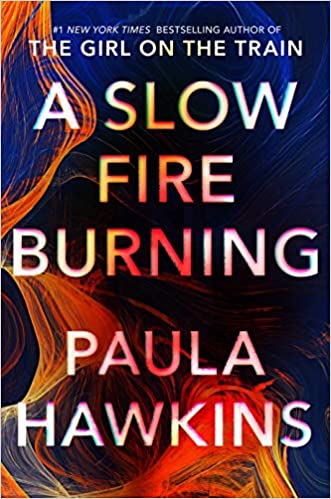
You’ve probably hear of the bestseller The Girl on the Train? This is Paula Hawkin’s latest, A Slow Fire Burning, and it is equally entertaining with its various twists and turns.
Laura is a hot-tempered, troubled loner who ends up in the wrong place at the wrong time. Her typical refrain is, “it wasn’t my fault.” But maybe people hear that too often? They want Laura to accept responsibility. At the same time, they disregard that she has a brain injury due to a childhood incident where she was hit by a car. Unfortunately for Laura, she was last seen with Daniel Sutherland. Now he’s turned up dead.
Miriam recognizes Laura is troubled. It takes trouble to know trouble. Miriam is the first to report Daniel’s death but she hides evidence and isn’t truthful with the police. Miriam knows Daniel’s uncle Theo, whose runaway thriller is actually based on her teenage years. Miriam has tried to bring legal action against Theo but he’s got money, and she doesn’t.
Carla is Theo’s wife, Daniel’s aunt. And she has been grief stricken for 18 years. Her 3 year old son Ben was being minded by Angela (Carla’s sister), and he fell to his death. Angela’s son Daniel was young at the time but whether it was his alcoholic mother or witnessing his cousin’s death, Daniel has always been a handful. Carla has secretly stayed in touch with Daniel.
Irene is Angela’s former neighbour. Turns out Angela died in a freak accident shortly before Daniel. But the police have ruled that death an accident. Also turns out, Laura befriended Irene on the day Angela died. Mm. So many layers.
A Slow Fire Burning is a great muddle of a mystery with revenge, heartbreak, and secrets galore. Great for fans of Little Fires Everywhere and other family dramas, psychological thrillers.
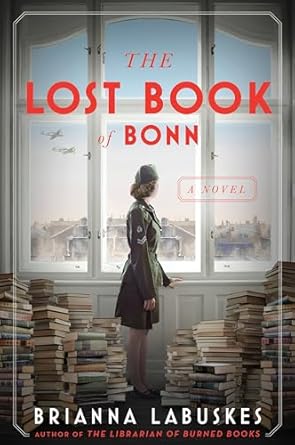
The Lost Book of Bonn is perfect for fans of Kate Quinn’s The Rose Code. It’s a story of bravery and resistance in the face of injustice.
The novel is set in Germany, 1946, with flashbacks to the 1930s and early years of the 1940s. Our protagnoist, Librarian Emily Clarke has just arrived in Bonn. She is there at the request of the U.S. Library of Congress, which is cataloguing and acquiring books plundered by the Nazis. There are divisions in the massive depot where Emily works that are dedicated to determining if personal connections can be identified and returned to surviving family members, others that bring Jewish literature to refugees, and Emmy’s branch which takes key works stolen by high-ranking Nazis and assesses if they can be returned to their rightful owners or are available to be acquired by the Library of Congress and shipped to the U.S.
The background story is about how the Nazis tried to re-write history by stealing and destroying books and art, or by hiding and examining those works as a way to position themselves as superior. The story at the forefront is Emmy’s search to find the owner of a poetry collection by Rainer Maria Rilke that has a beautiful handwritten dedication of love on the title page: “My dearest Annelise, my brave Edelwiess Pirate.” Emmy is keen to find Annelise and her lover Eitan. Interwoven into that story is the love story of Annalise and Eitan. The chapters move between Emmy’s present day (1946) and that of Annalise and her sister Christina (1936 to 1943).
This is a quick read, an intriguing story, and a timely reminder that the consequences of war are felt well beyond the dates of the conflict.
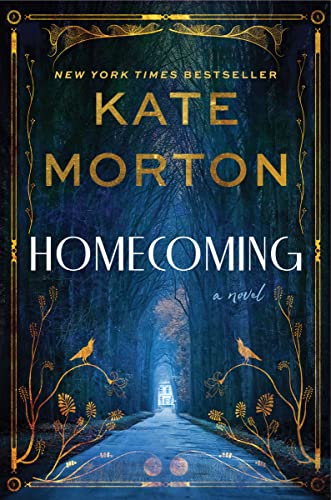
Homecoming by Kate Morton is a chilling novel about the mysterious death of a young Australian family on Christmas Eve, 1959. It’s literary fiction written in a true-crime style.
2018: Jess Turner is a struggling journalist who’s making ends meet in London when she is called back to Australia, where her beloved grandmother Nora has been hospitalized after a fall. Nora practically raised Jess after her mother Polly moved from Sydney to Brisbane without her. As Jess struggles to figure out what happened to Nora, to get Nora’s affairs in order, to deal with her estranged mother, she discovers her family’s connection to the brutal Turner Family Tragedy of 1959. As an investigative journalist, Jess is intrigued. As the connection to Nora and Polly becomes clearer, she is alarmed.
Christmas Eve 1959: Percy Summers stumbles across the sleeping bodies of Isabel Turner (English wife of a respected Australian businessman) and her three children (Matilda, John, and Evie). He does not realize that baby Thea is not present. The family is spread out on a picnic blanket under a walnut tree near a water hole, as if they were sleeping. It’s been a hot Australian day and storms and bushfires are on everyone’s mind. But all of their attention quickly focuses on finding baby Thea and figuring out if there is a murderer among them. What unfolds is an unusual story of small village dramas, love lost, and alliances formed.
Homecoming spans three generations and offers glimpses at the spellbinding nature of a family tragedy. It’s also a look at loneliness and how home is more than a place.
Home, she’d realized, wasn’t a place or a time or a person, though it could be any and all of those things: home was a feeling, a sense of being complete. The opposite of “home” wasn’t “away,” it was “lonely.” When someone said, “I want to go home,” what they really meant was that they didn’t want to feel lonely anymore.
In the acknowledgments, Kate Morton relays that the first ideas for Homecoming came to her in the Adelaide Hills, her family’s refuge during the “great unsettlement at the start of the Covid pandemic.” Instead of the hustle and bustle of London, they found themselves removed to a remote farm in South Australia. The uncertainty and loneliness of those early pandemic days must have informed the sentiments of Isabel Turner, displaced from London to a small Australian village, of Polly who never knew who her father was, of Jess, drawn to London and a busy career but never really belonging to either London or Sydney.
Homecoming is lovely and unsettling, beautiful and tragic. I really enjoyed this read.
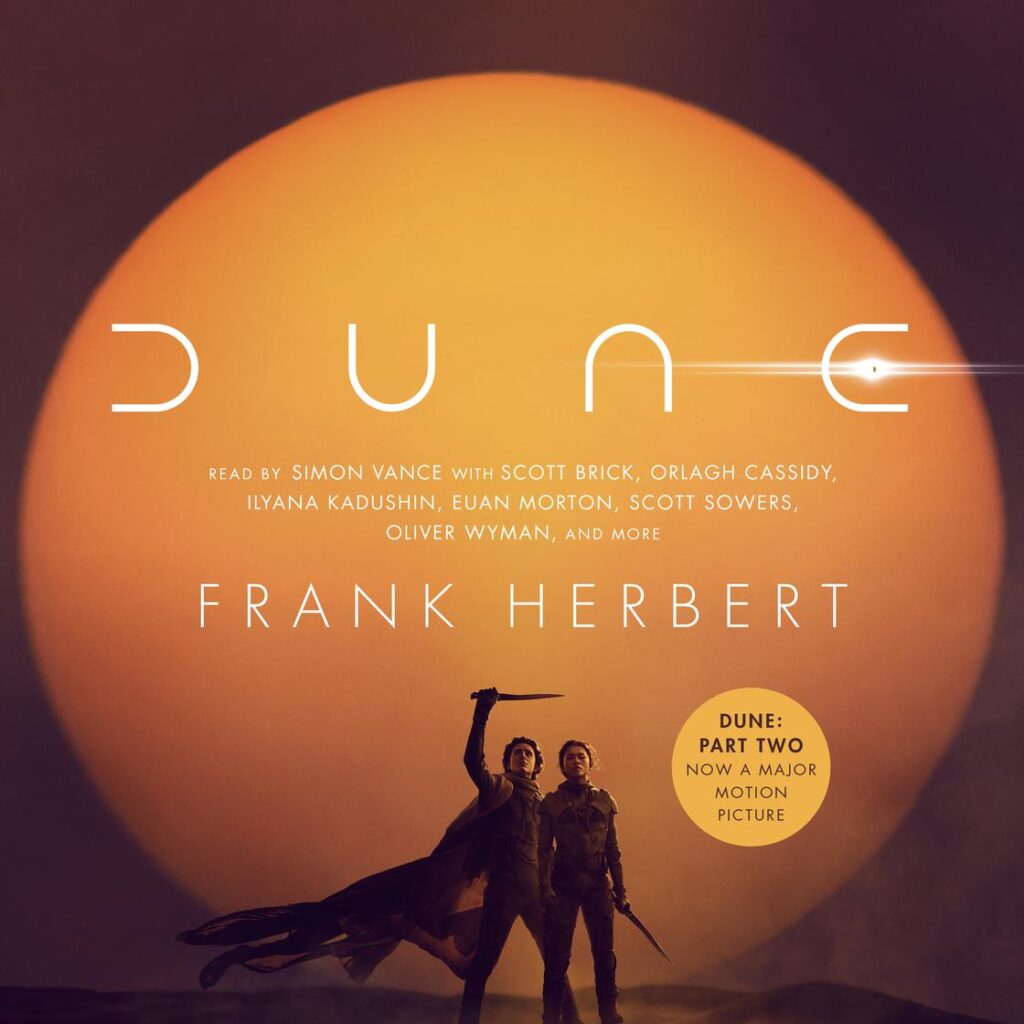
Prior to embarking on my Dune audiobook journey, I had little knowledge of this epic tale or its film adaptations. I have to say Frank Herbert’s masterpiece is worth the read. Dune is an intricate saga of struggle, legacy, resource management, and greed. At its core are Paul Atreides and his mother, Lady Jessica, who are deeply trained in the Bene Gesserit ways of reading people’s intentions and, for Paul, seeing possible visions of the future.
The story unfolds with the assassination of Paul’s father, Duke Leto, who knowingly walks into a deadly trap laid out by the treacherous Baron Harkonnen and the Emperor. The trap draws the Atreides family from their lush home world of Caladan to the arid desert planet of Arrakis, a land rife with giant sandworms and deadly storms. This harsh new environment is the sole source of the universe’s most valuable substance: the spice drug melange. Leto knows he’s being played but believes that the natives of Arrakis, the Fremen, are a worthwhile ally and that they can work together to solve the planet’s problems and form a better relationship with the Emperor. But, plots within plots and deep mistrust define the relationships between the various factions vying for control over the spice trade.
After the assassination of Leto, Baron Harkonnen puts his nephew in charge of Arrakis and is grooming another nephew to take over his place. Paul, the rightful ruler, narrowly escapes death and hides out in the desert with his mother Jessica. Paul and Jessica’s story aligns with a Bene Gesserit legend and the Fremen hiding them believe they are the ones spoken of in the legend. Paul may be destined to be the planet’s saviour, but as the narrative progresses, the line between hero and potential tyrant blurs.
The story is mostly told from Paul’s perspective but there are several passages recited by Princess Irulan, the eldest daughter of the Emperor. The excerpts from her journals and published works offer insight into the world of Dune, the Bene Gesserti way, and the legend of Paul, or Muad’Dib — the name adopted by Paul after he was accepted by the Fremen as one of their own.
In many ways the Bene Gesserti teachings act as a religion or yogic practice.
“I must not fear. Fear is the mind-killer. Fear is the little-death that brings total obliteration. I will face my fear. I will permit it to pass over me and through me. And when it has gone past, I will turn the inner eye to see its path. Where the fear has gone, there will be nothing. Only I will remain.”
This mantra, recited by Paul, encapsulates the essence of his training and the mental fortitude required for him to survive and thrive on Arrakis.
Yet Paul and Jessica’s abilities to perceive and influence the future also raise fascinating philosophical questions about destiny and free will. I find myself thinking about elements of this book more than I thought I would.
I love reading, but listening to Dune was excellent. The narration and sound effects expertly draw you into the world and add depth and dimension to the story. It’s also not surprising that the themes of Dune are as relevant today as they were when the book was first published in 1965. The struggle for resources, the dynamics of power, and the complexities of leadership and legacy resonate with the political struggles we see today. This is a story about colonialism, Imperialism, violence, and ecology.
The political intrigue and the multilayered conspiracies make for complex world-building equal to that of StarWars and Lord of the Rings. Herbert’s detailed descriptions paint a vivid picture of a desert planet and its original inhabitants and the tensions with its colonizers. The presence of the formidable sandworms and the harsh, stormy environment of Arrakis add to the sense of awe and danger that permeates the story.
I left the book wondering about Paul. He begins as a sympathetic character, yet his journey raises questions about the corrupting influence of power. Herbert leaves it unclear if Paul remains a hero or if he has succumbed to the very forces he sought to overcome. This ambiguity appeals to me, and it gives the novel a depth that’s missing from the binary good-evil of the StarWars series. I think there’s more to reflect on here about the nature of leadership and morality.
If you enjoyed the intricate political maneuvering and epic scale of Star Wars or the fantastical world-building and complex characters in the Wings of Fire series, then Dune is a must-read. Its blend of science fiction, adventure, and profound thematic exploration makes it a timeless classic.
Dune is available on Audible and through Libby, or from any one of Canada’s lovely independent bookstores (oh, yes and Amazon).
And if you’re interested in a deeper look into politics, ecology and what was happening in the 60s when this book was published, give this essay a read.
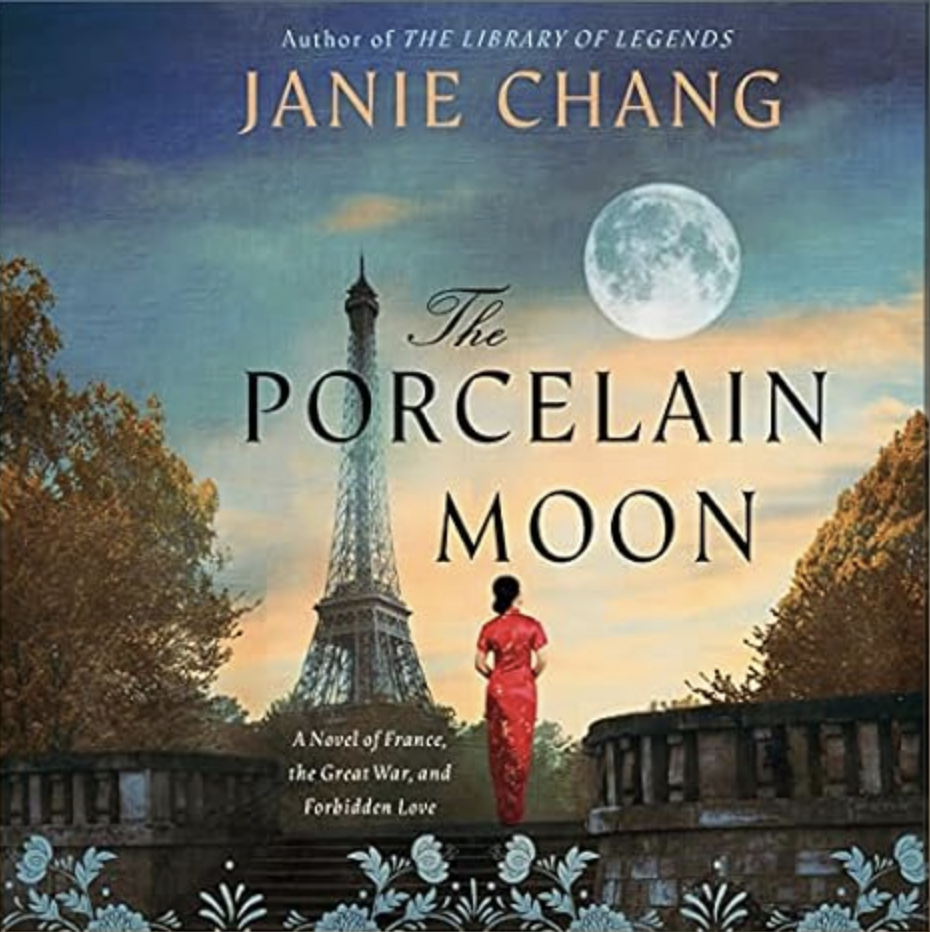
The Porcelain Moon follows the intertwined lives of two families during the final days of the First World War.
Pauline Deng is an illegitimate daughter, living with her Chinese uncle and cousin Theo in Paris. They run an antiques shop. Pauline is good with numbers and attractive, but her prospects are limited, and her uncle’s “first wife” is arranging Pauline’s marriage and return to China. Pauline secretly leaves for the town of Noyelle-sur-Mer, where she hopes to find Theo and convince him to negotiate her release from her uncle.
In Noyelle-sur-Mer, Pauline takes a room at Camille Rousell’s. Unbeknownst to her, the married Camille is Theo’s lover. Camille has married out of obligation and is secretly saving money to escape her abusive husband. She loves Theo but her situation is dangerous and she is determined to leave under her own steam.
These two women, trapped by marriage and the social obligations of the time, are bold and brave in their pursuit of happiness and independence. They are living during a well-documented time, but readers will be less familiar with the history of the 140,000 Chinese workers who were brought to Europe as non-combatant labour during the war. They were serving as civilians for the British and French, and faced discrimination and were subsequently written out of the history books.
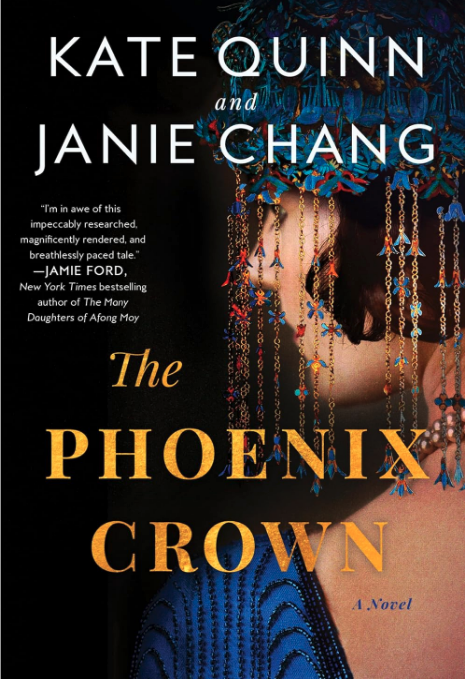
The Phoenix Crown is a spectacular confluence of two excellent historical fiction authors. I’m a big fan of Kate Quinn and had not heard of Janie Chang—even though she is a bestselling Canadian author. Oh goodness, I have a more to explore! (Thanks for the tip Rachael.)
The novel is set in San Francisco, 1906, just a before and after the earthquake, and subsequent fires, that devastated the city. Four women’s lives are intertwined based on their loose connections to a charming railroad magnate named Henry Thornton. Thornton claims to not be a very nice man, and that turns out to be the truth. He’s a collector and his objects are his heart. Too bad he collects women the same way he collects stolen Chinese treasures.
Thornton offers his patronage to Gemma (under-appreciated opera singer), Suling (Chinese embroidery legend and otherwise non-descript manager of the laundry), and Reggie (unknown yet phenomenal artist). His patronage represents career opportunities of a lifetime, but these women hardly escape with their lives. The forth woman? Botanist Alice Eastwood, who is a globetrotting, self-taught scientist, who is interested in Thornton’s prized plant, the Queen of the Night.
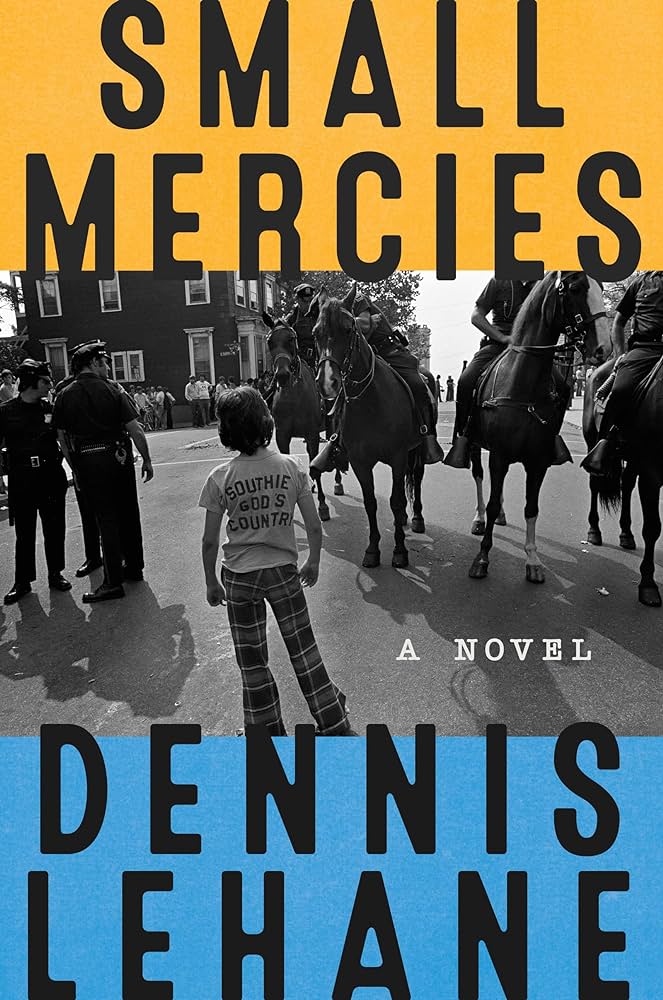
Hard to beat Stephen King’s blurb, “Small Mercies is thought provoking, engaging, enraging, and can’t-put-it-down entertainment.”
Set in the summer of 1974, during Boston’s heatwaves and on the eve of the desegregation of schools, there is a murder of a young Black man on a subway station in “Southie”, a neighbourhood known for poverty, drugs, and housing projects. The Irish immigrants and descendants of Southie are in an uproar about sharing their school and having half of their kids bussed to a nearby Black school. So on the surface the novel is a police drama and the crime seems to be that four Irish-American teens have attacked an up-and-coming Black man, whose only crime was having his car breakdown in the wrong neighbourhood while he was en route home from his retail management training program.
That indeed is the crime, but the novel unveils the systemic racism and rule of law that undermines the welfare of those four teens who are fed lies from early on and jacked up on drugs fed to them by the neighbourhood watchmen who are running girls, guns, and drugs.
The Irish mob has a stronghold on the community of Southie until Mary Pat’s daughter is one of the teens on that subway platform. Mary Pat is one tough Broad and she has now lost both husbands and both children to Marty Butler’s gang of thugs and way of life. She disrupts his shit in a way that not even the police can, and it’s her story of hate, poverty and crime that is the real power of the novel.
This is America’s version of Conrad’s Heart of Darkness, where human folly and racism lead to greed and cruelty at a scale that is nauseating.
If you enjoyed The Berry Pickers by Amanda Peters or Hell of a Book by Jason Mott then Small Mercies explores the same depraved indifference to human life, and the corruption the erodes democracy and exacerbates inequality, poverty, and division among communities.
Small Mercies by Dennis Lehane is published by HarperCollins Canada. And NPR has a a great, indepth review.
Fantastic story about a group of teens making their way through high school. In their case, it’s River Valley School for the Deaf, and unbeknownst to them changes are afoot.
Charlie is new to the school and has only a beginner’s grasp of sign language because her parents operated on the hope that her cochlear implant would bring the promised hearing that the doctors preached.
For hearing readers, the novel is more than revelatory. In fact the author’s note has quite a list of schools for the deaf that have closed over the last decade and throughout the book are references to how the Deaf community is forced to struggle.
Charlie is assigned to Austin, the school’s undisputed king of the school. Austin comes from a long line of deaf family members. He’s the opposite of Charlie when it comes to signing and he lives almost exclusively in the Deaf community. Austin’s world goes wonky when his parents have an unexpected pregnancy and the baby is born hearing.
February is the school principal and she assigned Charlie and Austin as buddies in the hopes that they’d teach each other new things. Feb’s parents were deaf and she is a champion for the kids and the school, but so many things are out of her control.
If you liked the film CODA and the tv series Wednesday, then this novel set at a boarding school for deaf students is up your alley. It’s charming and has all sorts of deviant behaviour. I learned a lot about sign language, disability and civil rights, and the continued injustice that the Deaf community faces.
True Biz by Sarah Nović, perhaps ironically, is an enjoyable listen.
This book is as beautiful and colourful as its cover.
Maame (ma-meh) has many meanings in Twi, but for Maddie, it means woman. That is her family nickname. She is not the head of the household, but she is the most responsible. Her mum regularly spends a year in Ghana running a family business, then returning to London for a short time. Maddie’s older brother James is away working and travelling in the music industry, and he never picks up on the first ring. Maddie is busy working as PA in a hectic theatre company but is otherwise at home caring for her retired dad who has Parkinson’s.
This is a smart, funny, sad, beautiful book about a young woman growing up, and fighting microaggressions at work and family friction at home. In some ways Maddie is comforted by the sheltered upbringing orchestrated by her religious mother and her Ghana traditions, but in other ways Maddie is ready to break out on her own.
When her mum returns this year from Ghana, she encourages Maddie to move out of the house. The rollercoaster that ensues has a hint of Bridget Jones’s Diary as Maddie aims to reinvent and improve her social life (and love life). It’s joyous, funny, awkward and heartbreaking. But it’s also a story of depression, social anxiety, and grief. It’s about growing up Black and dealing with stereotypes.
Maddie’s parents moved to London as an opportunity for their children. But with an ill father and an absent mother and brother, Maddie has to navigate her identity solo. Her ability to speak Twi is mocked by various aunties, she has to deal with the “I’ve never dated a Black girl before” comments, a roommate questions her full-day of hair washing. The beauty of Maame is that Maddie loves to write and she has stories to share; the novel is presented as her telling her story through a mix of interior monologue, emails and texts, and background stories.
I think ultimately this is a story about belonging and the relationship you have with yourself. Maddie is worthy of so many things—especially positive attention from family, coworkers, and friends. I’m so glad she comes into her own.