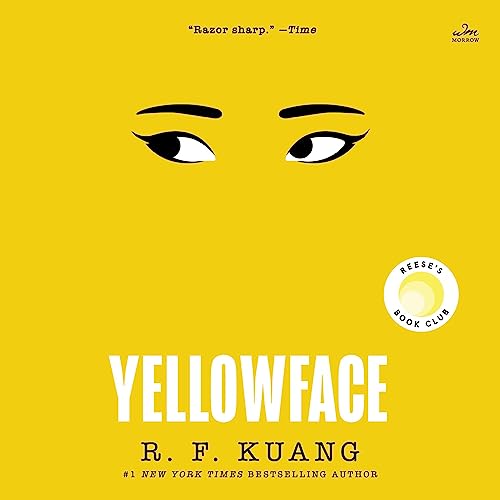
Yellowface by R.F. Kuang is full of lies and half truths, and I’m not sure we know which is which, even at the end. This is a classic, unreliable narrator, and she is not charming.
June Hayward is envious of her more successful author friend Athena Liu. When Athena unexpectedly dies, June finds Athena’s unpublished manuscript in her hot little hands. June is our narrator, and she wants us to believe that she had good intentions, but I’m not sure.
Anyway, June’s version of Athena’s unpublished work is a runaway success story. I loved all the inside-publishing stories with the gossip, snark, and crazy deadlines. And I especially enjoyed the struggles June and her publishers face in terms of diversity, racism, and cultural appropriation. I think in novel form, some readers may feel more confident examining these issues.
If you liked, An Absolutely Remarkable Thing by Hank Green then this novel also tackles the highs and lows of social media fame and how friendships are formed and lost when celebrity status is up for grabs.
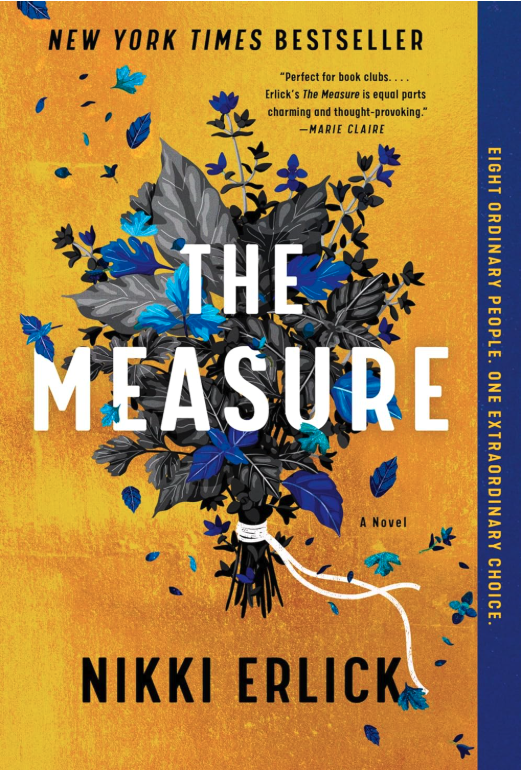
The Measure is set in a world where everyone over 22 receives a box with a piece of string that is equivalent to the duration of their life. The novel was published in 2024, so after the COVID pandemic. Like with the pandemic, the anxiety and fear either draws out the best or worst in people.
The Measure follows the lives of eight different characters, mostly New Yorkers, and how their perspectives on their lives change.
Nina (a magazine/newspaper editor) and her partner Maura (former musician, now working in publishing) have very different string lengths. Nina’s is long and Maura’s short. Their love story is perhaps the clearest through the novel. They are a solid partnership and weather the storm, with the expected ups and downs.
Amie is Nina’s younger sister. She’s a teacher and decides, like some, to not open her box. When she starts writing letters to an anonymous pen pal in a “short-stringer” support group that meets in the evenings in her classroom, we see the supportive yet strained relationships that many are having.
Anthony Rollins is a manipulative, long-stringer politician, who is running for president, exposing his short-stringer competitors, and generally making an ass of himself by fear mongering and implementing stringist policies.
Rollins’ nephew Jack is a long-string solider who secretly trades strings with his bestie Javier.
Javier is a short-stringer who won’t accept the Administration’s limitations on his dreams. He’s going to be a military hero.
That leaves Hank (doctor) and Ben (architect) who meet Maura at a short-string support group and become lifelong friends (pun mostly intended).
My favourite part of the novel is a protest movement, #strungtogether. It’s the counter to political divisiveness and promotes compassion and solidarity. The protesters urge their communities to support each other, regardless of their string length, and they create beautiful art that highlights the extraordinary contributions of people who’ve lived short lives, think Martin Luther King, Mahatma Gandhi.
That positive narrative is woven into the stories of the eight main characters and the supporting people in their lives.
As a novel, it’s a great philosophy exercise to think about the measure of your life, how you’d measure it–ideally not just by length but by strength.
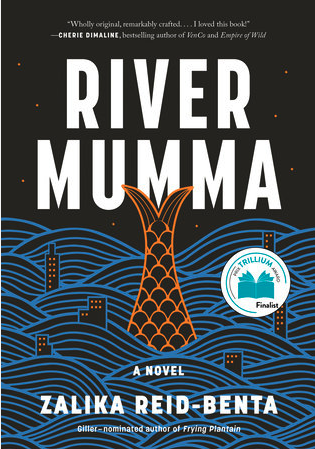
Alicia, Mars and Heaven are twenty-something coworkers who find themselves on a quest to return River Mumma’s comb. They share knowledge of their Jamaican heritage in order to move through different stages of the quest.
Alicia is the first to see River Mumma, who appears to her late one night as she walks home alone through a dark Toronto park. River Mumma drags Alicia down into a river where Alicia sees her ancestors and starts to reconnect to the magic and folklore of Jamaica. In contrast, Heaven, who is most knowledgable of her heritage, is the last to see River Mumma. Her pride and convictions work against her, but her friendship with a healer really saves the day when Alicia and Mars are infected wtih duppie sickness (duppies are malevolent spirits who chase the trio through the city, preventing them from completing their task).
River Mumma has a quiet level of magical realism to it. Yes, there’s a diety, a quest, duppies, and weird, unexplainable stuff that happens but it’s mostly a novel about accepting your family history and embracing your life journey.
The Society of Unknowable Objects is about a group of four who protect a collection of magical items and are constantly on the lookout for other magical items that can be added to their collection.
Magda Sparks is one of the members and she loves magic. Her mother was in the society and when she died, Magda was given her place. This is how the society runs. Each member has been handed down the responsibility. Frank Simpson is the self-proclaimed director, Henry (Henrietta) is an absent member, and Will is a reluctant member. So really it’s Frank and Magda. But when a connection to Will’s father turns up with a magical chess piece, everything Magda believes about the society is blown out of the water. Will and Henry reveal to Magda that Frank has been keeping secrets. Magda learns how to use magical items, which has always been forbidden by the society. And she learns that her mother’s death was unlikely to be an accident.
To add to the drama, entering the chess piece to the collection becomes impossible when it’s stolen by a madman wielding a gun and another magic item. Unbeknownst to the society, there’s a lot of magic floating around that has inadvertently fallen into the wrong hands.
The Society of Unknowable Objects is by Scottish author Gareth Brown, the bestselling author of The Book of Doors, another fantastical novel about magical books that give the owner special powers. They too need to be locked away and protected. Seems I neglected to review that one. It was fantastic and I enjoyed it more than this one. In The Book of Doors, Cassie Andrews is slogging her way through a low-paying job when she is unexpectedly gifted a beautiful book full of strange writing and mysterious drawings. Cassie quickly realizes that the book allows her to open a door anywhere in the world. She uses it to travel and eventually learns she can time travel as well. Her roommate/best friend Izzy warns her not to use the book. And when a stranger starts following them, Izzy’s worst fears come true. There are many magical books and many nefarious characters vying to get their hands on them. Drummond Fox, the “librarian” may be their only hope but he’s running from his own tormentors.
Overall The Society of Unknowable Objects is a fun, flight of fancy. I found it hard to get into at first but the story picked up the pace halfway through and was enjoyable.
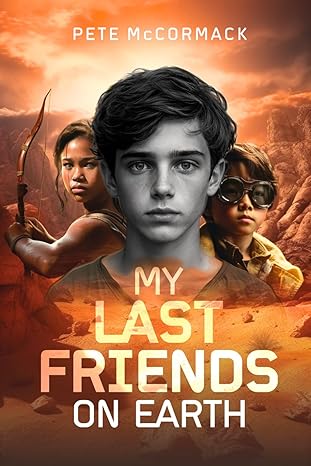
My Last Friends on Earth by Pete McCormack is a young-adult sci-fi novel about the last human on Earth, who escapes a lab and his captors, finds some unlikely friends, and defeats (or at least survives) an army of bots and aliens who are seeking to destroy him.
The novel opens with humanity on the brink—actually, past it. A devastating alien invasion has wiped out most of the population, but 15-year-old Harlo Kanu is the last human left inside a data lab. He’s kept his head down to avoid attention but suddenly the lab data on his brain shows that there’s intel there that Tri-General Nezkaban wants destroyed. Harlo doesn’t know what’s in his data, but he knows that his time is up. With the help of two of his captors and a mutant creature, Harlo is able to escape the unescapable lab.
That escape kicks off Harlo’s awareness of a small resistance group. He meets a former Queen, a fierce warrior, a brilliant 9-year-old weapons designer, a techni-colour dreamcoat scientist, and a mysterious collective known as the Council of Many Sizes. It’s quite the cast of characters!
What follows is a fast-moving fight not just for survival, but for truth, connection, and the possibility of a future.
YA sci-fi is not my usual genre—but author Pete McCormack is my friend and I can absolutely see why this book is finding readers.
It’s imaginative and energetic, with a clear sense of stakes right from the start. There are plenty of exciting moments, near-misses, and cliffhanger-style turns that make it easy reading. The world-building here is big, sweeping, and ambitious—at times it reminds me of a younger, more accessible Dune, with layered systems, factions, and a sense of a much larger universe beyond the page.
The heart of the book is about friendship, resilience, and refusing to be broken. If you like scrappy heroes and strong found-family vibes, this will hit the mark.
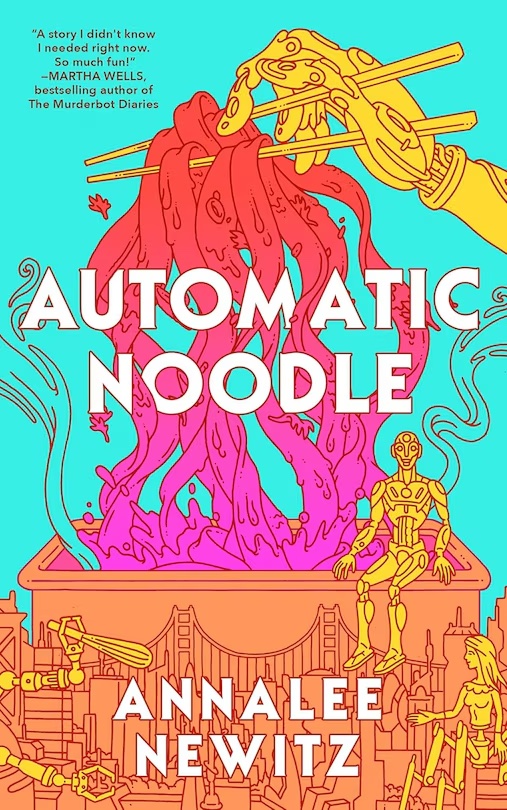
Annalee Newitz’s writing in Automatic Noodle is as fun as the cover. The story is about a set of robot friends who run a fast-food joint and are trying to work off their contracts. These robots were deactivated after the California-US war, and they find themselves in various states of “free”. Some have higher debts and worse contracts than others. But what they all share is a passion for making delicious food, which is not what the current owners of the joint care about, but those owners have renegade on their lease and are awol.
One of the bots speaks to a block-chain bot and gets the lease put into a new name. The bots have set up a shell company to hide the fact that they are now in charge because although the war brought them their “freedom”, they are still indebted and not allowed to own businesses.
This fun sci-fi novella is a nod to San Francisco, noodles, the imperfections of capitalism, and the continued algorithmic madness guiding human (and robot) lives. If you’re looking for a bot-friendly read sprinkled with some heavier philosophical moments, then this is a great next pick. It’s lighter and shorter than Klara and the Sun by Kazou Ishiguro but has some of that reckoning about robot and human relationships. And it has some of the post-war collapse yet optimism of Station Eleven by Emily St John Mandel.
In some ways this was a weird book to finish on International Women’s Day but it perfectly portrayed the ongoing struggles still faced by many women around the world.
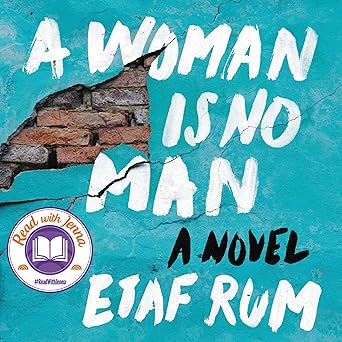
A Woman Is No Man is the heart-wrenching, interconnected story of three generations of Palestinian women living together in Brooklyn in the 1990s to 2000s.
Isra is trapped in her marriage. She was born in Palestine and married off to an American Palestinian man at the age of 17. She is expected to serve her mother-in-law Fareeda by doing the cooking and cleaning, and birthing boys who will carry on the family name. Isra has been taught to see this as her only role. But she’s a reader and believes in romance. So when living in America does not mean she’s living the American dream, she has to recalibrate. But domestic violence and the lack of agency over her life is crippling.
Deya is Isra’s eldest daughter. The story moves between her early years and her perceptions of Isra as an unloving mother to her teen years when she is being set up with suitors and forced into marriage vs. college. Deya is suffering from her oppressive, traditional upbringing but she’s afraid to rock the boat for fear of bringing shame to the family and damaging the reputation of her three younger sisters. The big question of the novel is whether Deya will be able to choose a different path, without being ostracized from her family.
Fareeda is Deya’s grandmother and Isra’s mother in law. She is the one demanding that the women in the house follow cultural rules. Fareeda, whether intentionally or not, isolates Isra and ignores the abuse she faces at the hands of Adam, Fareeda’s eldest son. On top of that, Fareeda regularly insults Isra for bringing four daughters into her marriage. When Isra dies, leaving her young daughters in the care of Fareeda, it means that Deya is at her mercy. Fareeda is a victim too though. She’s entered an arranged marriage as a teen, is uneducated but strident in her work ethic, she suffers domestic abuse, the death of children, relocation to America, and the loss of community supports. She does not embrace America and holds her sons at a different standard than her daughter and daughters-in-law. Can she abandon her beliefs and see a different future for her grand-daughters? No spoilers here.
Obviously the story is fiction and is not reflective of ALL Palestinians. But it is an exploration of the code of silence many abuse victims follow, it is a look at the different standards and expectations some families set for their daughters vs. sons, and it is a way to empathize with women who find themselves in ultra conservative families and communities.
I loved this woman’s passionate review and perspective on Islam, Arab culture, and the role of women.
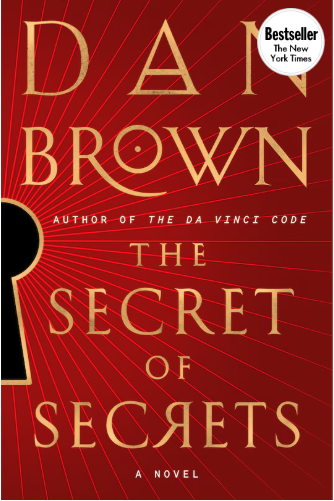
The thing I liked about The DaVinci Code was the huge amount of background research into art history and religion that informed the book. If it was an academic paper, nobody would have read it. In the case of The Secret of Secrets, this is the culmination of Dan Brown’s research into neuroscience and Noetics. In the AI space, there is a ton of chatter about consciousness and mindfulness so I was loving this book.
Symbologist Robert Langdon is accompanying his girlfriend, who is researcher and prominent noetic scientist Katherine Solomon, to Prague. Solomon is there to present her theory of nonlocal consciousness, suggesting awareness can exist beyond physical death or bodily limits—meaning that consciousness exists outside the brain rather than being produced by it. Solomon has been invited to give the prestigious talk by an equally prominent Czech neuroscientist Dr. Brigita Gessner who turns up dead the morning after Solomon’s talk.
Robert Langdon is then in a high-stakes race to protect himself and Katherine’s life, while solving the mystery behind Gessner’s death and the conspiracy, or perhaps treason, happening within the US embassy in Prague and the CIA. Katherine’s manuscript for her upcoming book seems to be the root cause of the threats and drama unfolding, but there’s no immediate clue as to why she and Langdon have become targets. Czech intelligence officers, an embassy attaché, Langdon/Solomon’s editor in New York, and a host of others either end up dead, kidnapped, or shot at in this deeply complex story. And there’s a Golem character, which in Jewish folklore is fashioned out of clay and brought to life through mystical rituals involving Hebrew letters. According to interviews I read with Dan Brown, this is an AI metaphor, the golem is an inanimate object that can be infused with consciousness.
Coming back to the science (or science fiction, depending on your beliefs), I’m a fan of the “brain receiver” theory Katherine proposes in the book. The idea is that the brain is like a radio receiver and tunes into a channel of thoughts. The reception is weakest when we are at the moment of death, and near-death experiences and brain trauma can also affect the reception—providing those moments of extreme awareness. One theory is that lowering GABA levels (a neurotransmitter) can expand awareness. There’s lots of counterpoints made by traditional neuroscientists but I was intrigued by recent research into anesthetics and what happens to consciousness when we’re having surgery. The research suggests that anaesthetics cause unconsciousness by inhibiting quantum vibrations within microtubules inside brain neurons (not GABA, as previously believed). So if these tiny tubes in our brain vibrate at quantum levels (hello universe) then it’s possible that consciousness is connected to the universe, right?
Anyway, I like to geek out on neuroscience and this was definitely a fun read. It’s more thriller than unrefuted science but the technology described in the book exists, the theories are out there and being tested, and I love the history, art, codes, and treasure hunts in this book enough to gloss over the clunky, genre-fiction writing. It’s definitely an entertaining read, lus, I’ve been to Prague and it’s magical. What a great setting for a book.
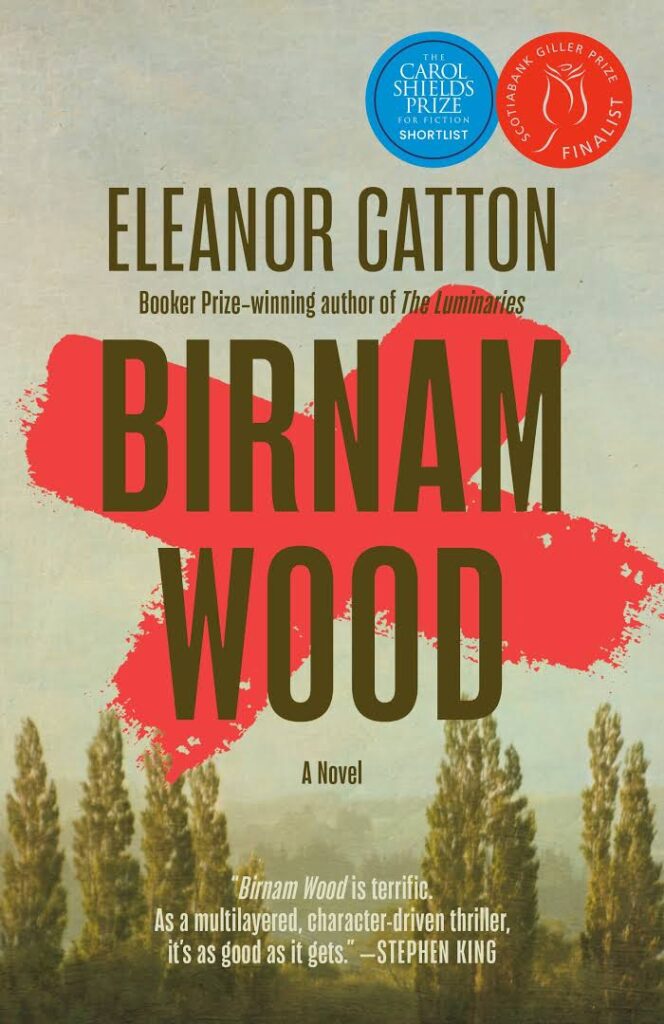
Birnam Wood is a psychological thriller from the New Zealand writer Eleanor Catton, Booker Prize-winning author of The Luminaries. Birnam Wood is a leftist, guerrilla gardening collective fronted by charismatic Mira and run by under-appreciated Shelley. On the surface, the group makes decisions by committee and runs in a flat hierarchy. But really the group leader is Mira, who is much admired by the group, along with her sidekick Shelley, who actually does all the admin, paperwork, social media accounts, and finances. Shelley is looking to get out. But a few unfortunate incidents collide and scupper her plans.
First, there is a landslide on New Zealand’s South Island that has cut off the town of Thorndike, leaving a sizeable piece of land abandoned. It’s owned by newly knighted Sir Owen Darvish and his wife Lady Jill, which is how, through news reports, Mira discovers her opportunity to guerrilla plant huge gardens on the abandoned property. The group is not involved in her decision.
Second, on a reconnaissance mission to the property Mira meets American billionaire Robert Lemoine, who is in the process of buying the property (sale not yet complete). Lemoine is devious and is secretly mining in the national park adjacent to the property. He doesn’t divulge this to Mira but instead presents her with the opportunity to be his investment project. Lemoine is offering Birnam Wood 10K to see what they can do with the, as of yet unsanctioned, garden. It seems legit to Mira, who is secretly hoping that the funding will appease Shelley and keep her on board, but who is also afraid the group will vote against the proposal given that they are essentially against capitalists.
Third, Tony Gallo arrives on the scene. Tony is Mira’s long-lost love. They hooked up on his last night in town before he ventured off to make his name as a journalist in South America. Tony has returned to New Zealand, not a hero, but still has his activist sensibilities intact. Tony arrives at the hui (the meeting) where, unbeknownst to him, Mira is going to introduce the Thorndike project. Everything goes off script. Tony insults another member of Birnam Wood, he’s an arse in his monologue about politics and gender and is on his heels when Mira arrives late to the meeting, is surprised to see him, and blurts out the announcement. Tony then rallies ardently against the project, and subsequently finds himself kicked out of the group.
That puts into motion a tragic series of events as Mira, Shelley and the group go up to Thorndike and get embroiled in murder, environmental destruction, and the covert operations of the enigmatic billionaire.
There is a lot of drama in this novel, especially in the third part. And nobody wins in the end. Birnam Wood is about greed, avarice, pride, lust, envy — maybe it’s all seven sins! Mira, Shelley, Tony and Robert all demonstrate actions that are based on pride. Robert is certainly a greedy liar whose desire for wealth colours all his actions. He’s the most gluttonous of the lot, not necessarily for food and drink but for stuffing his pockets. Mira and Tony lust after each other. Mira and Shelley lust after Robert. There’s certainly selfish and resentful feelings of envy felt by Mira, Shelley, and Tony. Anger and wrath are felt by Mira, Shelley, Tony, Robert, Owen and Jill. But sloth–hard to fit this into the story. There is some apathy on Mira’s part–take the money, take the lazy route out. Tony definitely fails to use his talents. The book copy describes Birnam Wood as Shakespearean in its drama, and Austenian in its wit. So maybe there’s more to the Macbeth reference than I initially thought.
Anyway, I found the New Zealand references to personality and culture really interesting and the novel as a whole was disturbing. A perfect thriller.
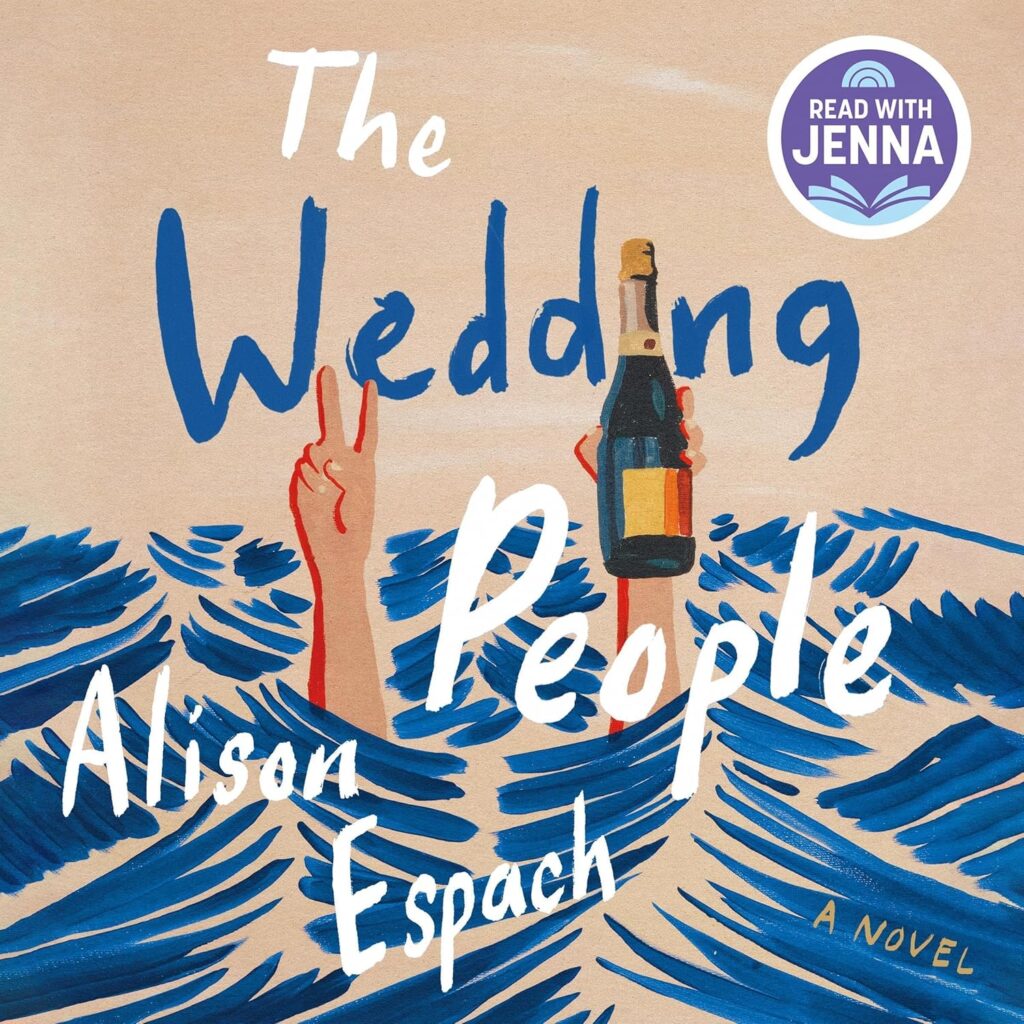
The Wedding People is about growing up and learning to let your internal motivations and desires drive you vs. letting external drivers take ahold of your life.
It begins with Phoebe walking into a Victorian inn in Rhode Island, intent on committing suicide that night. She has the gown on her body and no luggage. The plan is a delicious room service meal, a nice bath and then to take her cat’s medication and overdose. Weirdly, Phoebe walks into a wedding.
The hotel is fully booked out for the wedding, but for some reason her reservation for the penthouse suite was honoured. Phoebe meets Lilah the Bride, is hugged and feted, given a gift bag and checked into her room. But when Phoebe and Lilah find themselves alone in the elevator together, the truth of the situation comes out, and the Bride turns into Bridezilla as she discovers Phoebe’s plan. “You cannot do this to me! It’s MY wedding.”
The rest of the novel is a hilarious back and forth between determined Phoebe and hysterical Lilah. Phoebe, once determined to commit suicide, finds that she’s actually quite determined to live her life. She resorts to being upfront about her feelings, needs, and desires. It’s refreshing! Her honesty forges a bond between herself and the bride. Lilah doesn’t feel like anyone is being honest with her. The bridesmaids let her walk about with food in her teeth. Her future groom is maybe not the best choice for her. She’s angry at her mother.
This novel has all the terrible (and funny in retrospect) things “wedding people” do as guests and members of the wedding party: The terrible, embarrassing speeches, the rude behaviour of future in-laws, and the catty quips from guests about the costs, the location, the choice of decor. But it’s also an absurdly funny and devastatingly sad look at how some people find their way to the alter, into a job, or onto a path that isn’t right for them. No spoilers: but there is a happily ever after.