Plain words, uncommon sense

Category: Book Reviews (Page 37 of 45)

The Book: A Week in Review

More things happened than I have links to, but here’s the skinny on the fat:

1. WeBook.com, a great collaborative writing tool or user-generated book writing tool, got a $5M deal led by Vertex and Greylock Partners.

2. Crab Whisperer: James’ exploit hand-catching crabs is caught in VanMag. (Ok, not book related but publishing related.)

3. Stowe Boyd has a great list of the tools he uses. I’m there baby! (Yup, also not book related but Stowe is awesome.)

4. ATM for books: Print on Demand. “Angus & Robertson today became the first Australian book chain to install the Espresso Book Machine (EBM), capable of printing, trimming and binding a paperback book on demand within minutes.”

5. BookNet Canada and the Association of Book Publishers of BC ran a full day session on internet marketing for book publishers. I presented on understanding and measuring results and will post those notes over the weekend.

Book Review: Graceling by Kristin Cashore

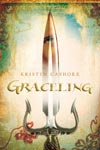
imageHarcourt continues to publish some of my favourite children’s books. In fact I would happily read any of their teen and young adult titles, especially anything by Ursula K. LeGuin (who’s coming to the Vancouver writers’ festival) and Kristin Cashore.

Kristin Cashore is the author of Graceling, a fantastic first novel about a land of seven kingdoms where only a few people are born graced. A Grace is an extreme skill, i.e., Martha Stewart would be graced with domesticity, Usain Bolt graced with speed. Of course there are graces that are frowned upon: killing being one.

Katsa is a Lady in the Kingdom of Randa, and she is graced with killing. Which makes King Randa pleased. He can be a brute to his citizens and neighbours. Katsa must do his bidding. That is until Prince Po comes along. He is graced with fighting (or so it first appears) and he reveals to Katsa that her skill is really survival.

Graceling is a fantasy books in the same vein as Ursula K. LeGuin’s Gift trilogy. I recommend it for the fast pace, adventure and solid writing.

Graceling by Kristin Cashore is published by Harcourt Books.

Book Review: Downtown Owl by Chuck Klosterman

I’m ready to read anything by Chuck Klosterman. So far Downtown Owl is my favourite book of 2008.

Klosterman’s sense of place in the novel Downtown Owl is spot on. In Canadian terms, he’s the comedian that Sinclair Ross wasn’t.

Sharp, witty, observant: I can’t say enough about Klosterman’s depiction of the town of Owl, North Dakota, and 4 of its inhabitants. Everyone knows everyone but they don’t know their inner thoughts, hopes and fears:

* Mitch, the football kid who doesn’t fit in.
* Julie, the new meat woman in town who has everyone’s attention (men at the bar anyway).
* John Laidlaw and his young girl vices.
* Horace–widower.

Horace is by far the only 1 of the 4 who deserves his end.

The stories are short stories that are inter-connected to form the novel. It is a novel rather than short stories but really any chapter could stand on its own. I’m particularly fond of a chapter in the middle of the book, “November 23, 1983” (page 129). It starts:

Quote: Edgar Camaro was Satan. Or at least an idiot. Or at least he was when he rolled dice, or at least that’s how it seemed to Horace.

Horace had two secrets. One of them was dark and sinister, as most noteworthy secrets tend to be. The second was less awful but more embarrassing, which is why it became the secret he despised more.

This particular chapter is a masterpiece and I really wish I could share it with you hear, but I’ve asked and no such luck. You can, of course, have a look at this chapter on Mitch.

Downtown Owl by Chuck Klosterman is published by Scribner (S&S) and you absolutely should read it.

Book Review: Nicholas by Goscinny & Sempé

Welcome to Nicholas, or rather welcome back Nicholas. Nicholas is the energetic French schoolboy who is forever in some kind of trouble. His exploits are brought to life by Rene Goscinny, the author of Asterix. The series was originally published in France in 1959 and is now available in a gorgeous hardcover edition by Phaidon.

The cover looks like it’s covered in cloth or linen and Nicholas is set into the cover. The interior sketches are also really cool.

The Nicholas series published by Phaidon. The short stories are a bit predictable but funny nonetheless.I like Photograph to Treasure in which the boys are so misbehaved the class photographer has left by the time they’ve settled down to have the picture taken. Or Playing Cowboys in which Dad gets tied to the tree and then forgotten. Or Playing with √áuthbert, who everyone really just wants to punch in the nose.

Book Review: Petite Anglaise

imagePetite Anglaise is the pseudonym of Catherine Sanderson, English blogger living in Paris and the author of a new book Petite Anglaise (published by Random House).

Catherine/Petite has an engaging and hilarious writing style, which appears perfectly fine-tuned in her book. You can appreciate my fandom here when I say that publishers often make the mistake of publishing bloggers and thinking that what’s compelling in a couple of paragraphs can be morphed into a full-length book. Such trepidation is not required when reading Petite Anglaise (book or blog). From blog to book really works for Petite Anglaise–a blog that sits on that fine line between reality and embellishment that is often prevalent in autobiography.

Quote: Here’s a quote from a recent blog post titled “Fraud”

I fully intended for this post to be a witty open letter to the person who stole my identity and used my bank card for an extravagant online shopping spree (total cost: 3.285,17). Or perhaps a song, in the style of Brassens, who in Stances un Cambrioleur so eloquently thanked the burglar who had the good taste to pay his house a visit.

It would have described my joy at receiving a letter from the Caisse d’Epargne, heavy with menace, which informed me, in typically verbose (but not particularly comprehensible) French, that having noticed repeated dysfonctionnements consecutifs a l’utilisation de ma carte bleue, I was invited to “regularise” the resulting overdraft. If not my card would be cancelled, my bank account immobilised, the Banque de France notified, and helicopters would be dispatched to hover outside my apartment window so that men in uniforms could shout at me over their loud hailers and/or airbourne snipers could get me in their sights.

The book chronicles the birth of the blog Petite Anglaise and the subsequent consequences. Catherine, a young Englishwoman in Paris, in love with all things French, is feeling a little less than loved by Mr. Frog (her husband) and less than in love with her job. The discontent and the discovery of blogging results in an anonymous blog Petite Anglaise. Catherine shares the intimate details of her life in what she hopes will be read by Mr. Frog but instead captures the attention of many bloggers and blog readers. Apparently 100,000 visitors per month.

And like all anonymous and wildly popular bloggers, Catherine eventually reveals herself at a blogger meetup. She develops some very well-formed relationships with her readers, one of which is a little too well formed and it rattles her family substantially and tempts her to abandon the real life she’s created. But I’m not going to tell you what happens to Mr. Frog and Tadpole (her daughter).

Petite Anglaise (on Amazon.ca) by Catherine Sanderson.

Petite Anglaise (the blog)

Book Review: The Magician by Michael Scott

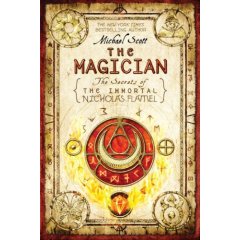
imageThe Magician is the second book in the series “The Secrets of the Immortal Nicholas Flamel” and I like it a lot.

The first book The Alchemyst introduces readers to the legend of Nicholas Flamel.

Flamel was born in Paris on September 28, 1330. He is acknowledged as the greatest alchemyst of his day and it is said that he discovered the secret of eternal life.

My Harry Potter friends will know about him and the Philosopher’s Stone.

The records show that he died in 1418 but his tomb is empty.

The legend is that he lives on by making the elixir of life and that the secret of eternal life is hidden within a book that he protects called the Book of Abraham the Mage.

Michael Scott’s series is based on this part of the legend–that the book, in the wrong hands, will destroy the world.

The Magician, Dr. John Dee, plans to steal the book and bring about its prophecy. The Alchemyst, Nicholas Flamel, must protect the book and the good side of the prophecy, which is that twins–Sophie and Josh Newman (regular kids) are the only hope.

The Twins have powers that can be awakened and if they stay on the right side of the battle, they can save the world from the Dark Elders.

I know in writing it seems flaky, but it’s a great, page-turning adventure. I like these fantasy books that are based in reality but have a side of reality that we just don’t see or understand. We ignore magic because it’s just not sensible.

6 books in the series. Books 1 & 2 are in stores.

The Magician by Michael Scott is published by Delacorte Press (part of Random House)

Book News Round-Up

Quick post of links I want to share and remember for later…

Borders is finally free of Amazon and has launched its own ecommerce site.

US Bookstores are looking for ways to pull people into the store: tvs, music and other digital bits. The US publishing industry is worth $37-billion according to this LA Times article. Good info about online marketing activities of publishers and who’s doing what.

E-books still unnerving publishers. “Jeffrey P. Bezos, the founder and chief executive of Amazon, spent much of a packed session on Friday evangelizing about the Kindle, which he said already accounts for 6 percent of his company’s unit sales of books that are available in both paper and electronic formats.”

Carolyn K. Reidy, the chief executive of Simon & Schuster, said “electronic book sales last year totaled about $1 million, a sliver of its annual sales of roughly $1 billion.”

And here’s something ironic. Despite the fears of e-books, “Electronic readers have nevertheless gained many fans in the publishing industry. Random House and Penguin, among others, have equipped their entire sales force with electronic-book readers, allowing them to avoid having to lug around as many preview editions of books. Editors at many of the larger publishing houses also use the devices to read manuscripts submitted by agents and authors.”

The National Book Critics Circle’s Campaign to Save Book Reviews is meant to thwart the disappearance of book review sections in newspapers and magazines.

More stats and facts about the declining coverage for books in the Columbia Journal Review. Interesting reader comments follow.

Wall St Journal on how the scarcity of ad revenue endangers newspaper book review sections.

New York Times on “Are Book Reviewers Out of Print?”

Fascinating look at Pan MacMillan’s publishing manifesto. Also interesting reader comments.

Book Review: The Man Who Forgot How to Read by Howard Engel

imageThe Man Who Forgot How to Read: A Memoir by Howard Engel is not a literary masterpiece but it is a masterful work. Howard Engel, author of the Benny Cooperman detective novels, woke up one day and discovered that he could not read the newspaper. Not the newspaper, books, street signs, any written text. In the night he suffered a stroke that affected the part of his brain responsible for reading. He could write but could not read.

The Man Who Forgot How to Read is Engel’s story of his struggle to regain reading, from the day of the stroke to the day of the manuscript completion that is this memoir. I say it isn’t a literary masterpiece because compared to something like Gabriel Garcia Marquez’ memoirs, this is plain writing. It’s not literary writing that flows into the memoir. It’s the straightforward story of a man who lost a significant part of his identity over night. An author who cannot read.

I do think it is a masterful work regardless. The incredible journey Engel takes in order to read and write and complete not just this manuscript but a new Benny Cooperman novel is worth recognition. Oliver Sacks, who writes the afterword, thinks it’s remarkable as well.

The Man Who Forgot How to Read by Howard Engel is published by Harper Collins Canada. Check out their website for more details on the book.

Book Review: The Good Lie by Don Bailey

I just finished reading The Good Lie by Don Bailey, novelist and coordinator of the Professional Writing Cooperative Education Program at the University of Victoria. Don is a great self-promoter and initially contacted me in October last year before my trip to Malta. We have some mutual friends, including novelist and editor Wayne Tefs.

Because of Don’s position in the literary community, I felt the urge to give this novel a rather academic reading. But I fought that urge and instead enjoyed it as a novel rather than as a literary exercise. What I like about the book most is that the ending is not the ending I expected.

The novel starts plainly enough. Paul is on a kayak trip, the last in a series of lessons. He and another guest become separated from the group during the foggy return trip. There is a boat that topples them into the water, some panic, and other drama, all of which results in the other guest going into a coma and Paul being investigated as part of a lawsuit.

The quote at the beginning of the book, by Ben Stillwell, Paul’s lawyer, sums up the main thread of the novel: “In this profession you see everything. The thieves, the cokeheads, the pimps and prostitutes–of course they lie. Everybody expects them to lie. But sometimes, the good lie, too.”

This is exactly what Paul does. He lies about Jenny, the other guest, panicking and nearly drowning him. He lies about knocking her off him with his paddle, which likely resulted in her coma. He lies to his wife about the sense of fear and threat he feels about the pending lawsuit. It’s a book of lies.

Normally Paul isn’t the type of character I have any sympathy for. He is a coward. I can’t say he is a redeemable coward but my sympathies for him do increase at the book goes on, and as I mentioned at the beginning, the end of this book is not what I expected.

The Good Lie by Don Bailey is quite an enjoyable read–part literary, part soul searching, part crime drama. Thank you Don for introducing me to The Good Lie.

For those interested readers of fiction, I noticed on Don Bailey’s website, TheGoodLie.com that there is a book club section that offers 27 different questions and conversation points. I definitely think The Good Life is book-club worthy and Don’s dedication to providing a worthwhile website for readers is commendable.

The Good Lie by Don Bailey (published by Turnstone Press).

« Older posts Newer posts »

© 2026 So Misguided

Theme by Anders NorenUp ↑