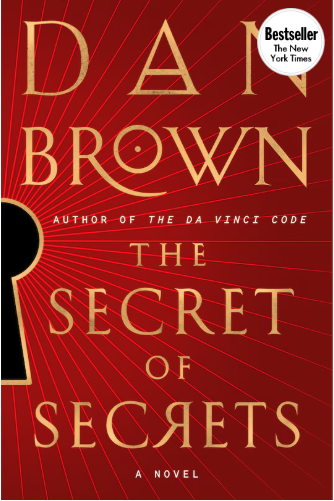
The thing I liked about The DaVinci Code was the huge amount of background research into art history and religion that informed the book. If it was an academic paper, nobody would have read it. In the case of The Secret of Secrets, this is the culmination of Dan Brown’s research into neuroscience and Noetics. In the AI space, there is a ton of chatter about consciousness and mindfulness so I was loving this book.
Symbologist Robert Langdon is accompanying his girlfriend, who is researcher and prominent noetic scientist Katherine Solomon, to Prague. Solomon is there to present her theory of nonlocal consciousness, suggesting awareness can exist beyond physical death or bodily limits—meaning that consciousness exists outside the brain rather than being produced by it. Solomon has been invited to give the prestigious talk by an equally prominent Czech neuroscientist Dr. Brigita Gessner who turns up dead the morning after Solomon’s talk.
Robert Langdon is then in a high-stakes race to protect himself and Katherine’s life, while solving the mystery behind Gessner’s death and the conspiracy, or perhaps treason, happening within the US embassy in Prague and the CIA. Katherine’s manuscript for her upcoming book seems to be the root cause of the threats and drama unfolding, but there’s no immediate clue as to why she and Langdon have become targets. Czech intelligence officers, an embassy attaché, Langdon/Solomon’s editor in New York, and a host of others either end up dead, kidnapped, or shot at in this deeply complex story. And there’s a Golem character, which in Jewish folklore is fashioned out of clay and brought to life through mystical rituals involving Hebrew letters. According to interviews I read with Dan Brown, this is an AI metaphor, the golem is an inanimate object that can be infused with consciousness.
Coming back to the science (or science fiction, depending on your beliefs), I’m a fan of the “brain receiver” theory Katherine proposes in the book. The idea is that the brain is like a radio receiver and tunes into a channel of thoughts. The reception is weakest when we are at the moment of death, and near-death experiences and brain trauma can also affect the reception—providing those moments of extreme awareness. One theory is that lowering GABA levels (a neurotransmitter) can expand awareness. There’s lots of counterpoints made by traditional neuroscientists but I was intrigued by recent research into anesthetics and what happens to consciousness when we’re having surgery. The research suggests that anaesthetics cause unconsciousness by inhibiting quantum vibrations within microtubules inside brain neurons (not GABA, as previously believed). So if these tiny tubes in our brain vibrate at quantum levels (hello universe) then it’s possible that consciousness is connected to the universe, right?
Anyway, I like to geek out on neuroscience and this was definitely a fun read. It’s more thriller than unrefuted science but the technology described in the book exists, the theories are out there and being tested, and I love the history, art, codes, and treasure hunts in this book enough to gloss over the clunky, genre-fiction writing. It’s definitely an entertaining read, lus, I’ve been to Prague and it’s magical. What a great setting for a book.