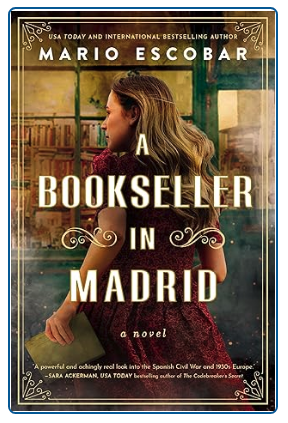
A Bookseller in Madrid is the story of the rise of Fascism in Spain the 1930s from the perspective of a German woman, Barbara Spiel, who dreams of opening a bookstore in Madrid.
On the one hand, this is obviously a well-researched book. The political and historical aspects of the story are based on well-documented tensions across Europe. On the other hand, the personal story is intriguing yet boring. The promise is there! Barbara meets a handsome young man in a Berlin bookstore during a raid. He stands up to the officers and later helps Barbara and the Jewish bookseller re-stack the shelves. The young man is a Socialist politician from Madrid, named Juan Delgado. Barbara moves to Madrid, hoping to escape Hilter’s influence in Germany, marries Juan, opens her bookstore, and discovers Spain is not immune. The Spanish Civil War breaks out, Barbara is asked to spy, she’s harassed by radicals from both sides of the political fence, is at risk daily, and, with war brewing across Europe, needs to escape her home yet again.
Sounds exciting right? But the writing is “this happened, then this happened, then this …” The story is framed with a first and last chapter set in present day. An editor in New York finds an aged and discarded manuscript in a dumpster and rushes to publish the ensuing work. This framing of the novel is unnecessary. There’s no mention of this setup throughout the story so it was a jolt at the end to read the last chapter, set in present day, and go “oh right, I forgot about that.”
The book is widely applauded for its historical accuracy and I’d echo those accolades. But this was not my favourite historical novel. I will give this author another try with The Librarian of Saint-Malo.