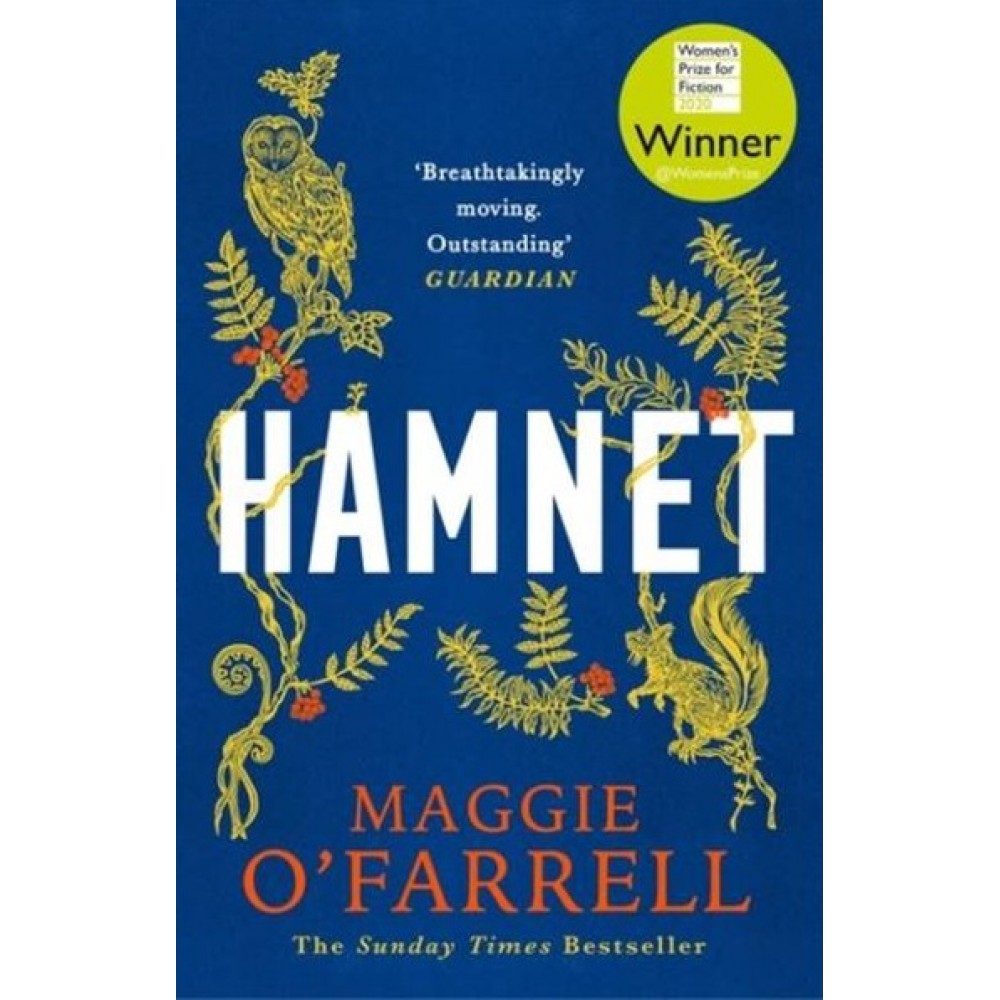
Gosh I liked this book. Hamnet is a fictional account of William Shakespeare’s son Hamnet, who died at age 11 in 1596, most likely from the plague. The story has very little to do with the Shakespeare we know and much more to do with the women in his life: his mother, his wife, his two daughters, and his mother-in-law.
The first part of the story moves between two different times: Shakespeare falling in love with Agnes, an unsettling, free-spirited young woman who keeps a kestrel and wanders the woods. Shakespeare, through the ill-dealings of his father, is sent to tutor Agnes’ step brothers. He is intimidated by her strapping younger brother who acts as her protector from the village and the step-mother. But Agnes has her eye on Shakespeare and the pair devise a way to ensure they get married. The narrative shifts back and forth between this time of optimism and present day 1596 when Hamnet is struggling to help his twin Judith through a fever. She has suddenly fallen ill and nobody is around to help. The grandparents are out, his older sister is off running errands, and his mother is absent (Agnes is at the farm with her brother who has asked her to come manage her swarming bees). The two narratives crash together with Agnes coming home from the fields and discovering Hamnet fraught with worry and Judith on death’s door.
The second part of the novel moves us through the family’s despair at losing Hamnet. Shakespeare retreats to the playhouses of London and Agnes abandons the plan for her and the children to join him there. It’s impossible to hope that Judith will survive the dirt of London, and it’s impossible for Agnes to return to life as usual.
I liked that this book is very much about the women vs. Shakespeare himself. There is darkness, tension, and the intensity of living through plagues set in parallel to the herbology and wisdom of women, the bonding and bickering, plus the love and grief of the women in this novel.
If you like historical fiction, twist on familiar plots, or award-winning literary fiction, then this is for you.
It reminds me of James by Percival Everett in its retelling of a seemingly familiar story. It has the “don’t let the wool be pulled over your eyes,” draw of By Any Other Name of Jodi Picoult, the dark tension of Small Things Like These by Claire Keegan, and it has the brilliant writing of females characters like The Women by Kristin Hannah.