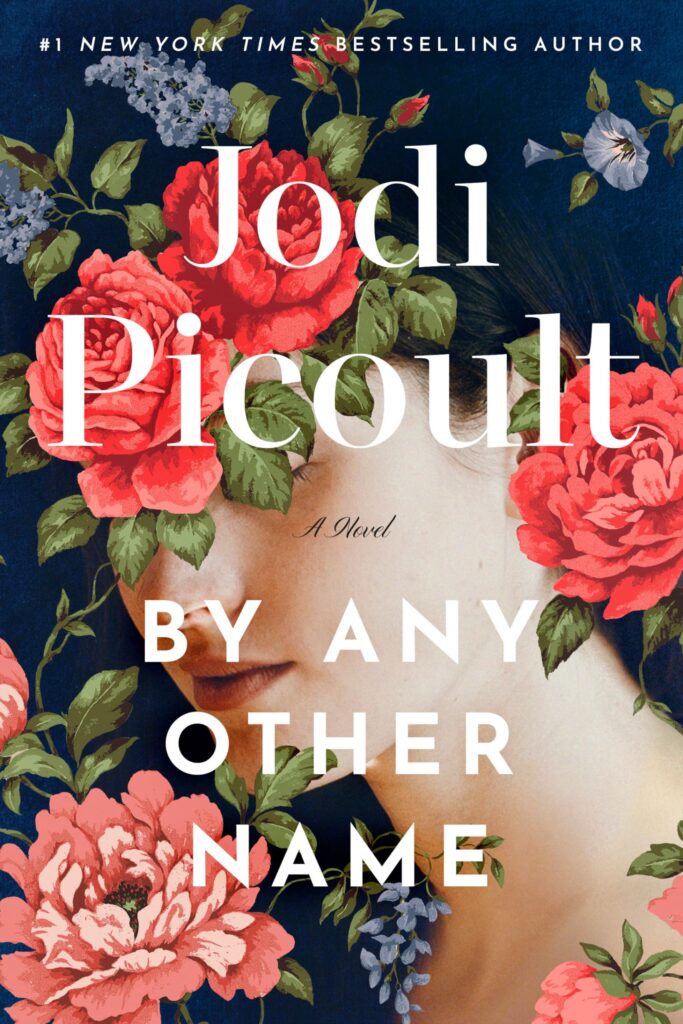
By Any Other Name by Jodi Picoult is a fictionalized account of Emilia Bassano’s life from age 13 to 76 (1582-1645). As a young girl, she is a ward of English aristocrats who school her on languages, history, and writing. But at age 13, Emilia is contracted to Lord Chamberlain as his mistress in exchange for her family’s long-term contract as the Queen’s musicians. Emilia is young, an Italian Jew, highly educated, and an aspiring playwright. It’s just not a place and time for women to flourish. Emilia has little say in her life; she is unable to write professionally, or to publish her plays and poetry. She is a dark beauty in contrast to the white, powdered faces fashionable in court. And, she has to hide her Judaism. The thesis of the story is that the Shakespeare we laud today was no playwright. He bought plays from those who wished to remain anonymous and published them in his name. It was a business proposition that suited both parties, but a mistake for modern-day fans to attribute so much praise to him.
The modern-day story interwoven with Emilia’s is that of Melina, a descendant who is also an aspiring playwright. Melina’s challenge is that of being a woman in a field still dominated by white men (playwrights, producers, funders, reviewers). Her attempt to get a play produced is marred by sexism and her own mistakes in how she presents herself.
By Any Other Name is a thought-provoking novel about attribution: false representation, ghostwriting, and allonyms (pen names).
Whether you read it as fiction only, or as an exploration of the mythology that has sprung up around Shakespeare (a man who managed to write 37 plays alone while simultaneously being a full-time actor and producer), Picoult weaves in a lot of doubt about the providence of Shakespeare’s work. Other playwrights and poets of the time reference each other and were lauded publicly at the time of their death or buried in Poets’ Corner at Westminster Abbey. They left behind books and manuscripts in their wills. Yet Shakespeare left none. It was a time when writers collaborated and edited and finished each others’ works, whereas Shakespeare is said to have written alone. His plays humanize Jews, at a time when anti-Semitism was the norm. He never spent time in court, in the military, reading law, visiting Italy or Denmark, or playing music, or educating his daughters. Yet his plays and sonnets are ripe with details about music, courts, and law. His female characters are rich, spirited, and educated. Yet he did not educate his own daughters.
There are naysayers. And there are theories that multiple writers collaborated and published under the name Shakespeare. Regardless, novel or not, Picoult reminds us that women writing in Elizabethan times, doing science, crafting medicines, playing music and writing plays for home performances paved the way for women writers today. The main premise of By Any Other Name is that just because there is an absence of evidence (of women writers and playwrights) doesn’t mean there is evidence of absence.
If you like Jodi Picoult’s work (see Mad Honey), Kristin Hannah, or Kate Quinn then definitely give this a read.