Plain words, uncommon sense

Month: June 2006 (Page 2 of 2)

Women in Film

Congratulations to Katherine Dodds, who will be honoured with a Women in Film and Video Vancouver award. The award is WIFVV’s Woman of Vision Award, and she’ll receive it this week.

Katherine is really great. In my mind, she’s most famous for handling the marketing of the movie The Corporation. But she does all sorts of stuff. Her company is Good Company and they run the Hello Cool World website.

Katherine is the perfect recipient of this award. The award honours a woman who demonstrates leadership and vision in an enterprise or project that combines traditional entertainment media with the use of new digital technologies. According to the press release: “Katherine was selected for this award for her ground breaking work producing multi-media projects that use the tools of new media to connect audiences, on and offline, with social issue films.”

She did this really cool thing that got people to plan Corporation Parties. It was sort of like Tupperware parties. People come to your house, you watch the movie and then you log on to the Hello Cool World site to engage in group conversations about how to fix the world.

Katherine has a lot of exciting ideas and I’m pleased that she’s being recognized. Congratulations.

Martini Madness at Mark’s Fiasco

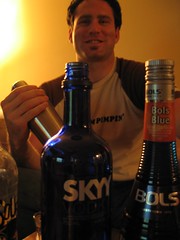
Shake ItMy friend Scott is competing in Martini Madness at Mark’s Fiasco on Thursday, June 15.

If you live in Vancouver and like martinis, come down to Mark’s Fiasco between 8 and 10 pm. For $10 you get 3 martinis and the chance to vote on the best one. Actually I will be voting for Scott’s martini, whether it is the best or not, but you can choose to be less corrupt.

Thursday, June 15
8-10 pm
$10 at the door

Mark’s Fiasco Restaurant
2486 Bayswater St. @ Broadway
604-734-1325

<-- Vote for this guy.

The Tyee Adds a Books Site

TheTyee.ca was started in November 2003 by David Beers, who’s renowned for bringing arts and culture news to British Columbians.

The Tyee is an independent alternative daily, and it’s all electronic, meaning you can subscribe to the RSS, you can receive updates via email, you can read and comment in the various forums, and you can enter cool contests.

And now, there’s books!

In addition to the usual mix of reviews, features, essays, interviews, and excerpts, the editors are promising eclectic reading lists, interactive discussions between writers and readers and daily coverage of book news from BC and beyond.

It’s exciting when new Book pages are born.

Here are the links to some of those cool contests I mentioned:

Win Tickets to Earth: the World Urban Festival
http://thetyee.ca/Contests/2006/05/30/EarthContest/

Win a Summer Reading Library! Tyee Books brings you BC publishers’ hottest recent releases.
http://thetyee.ca/Contests/2006/06/12/ReadingContest/

Made to Break

The nonfiction book that I’m reading right now is worth talking about well before I’m finished.

The book is Made to Break: Technology and Obsolescence in America by Giles Slade. The book is a history of consumerism and the factors that led American inventors and companies to deliberately create obsolence in consumer products. Ok maybe that doesn’t sound like simulating reading but it really is.

The book opens with the shocking numbers of computers and cell phones that are discarded annually. For example, “in 2005 more than 100 million cell phones were discarded in the United States.” That’s 50,000 tons of still-usable equipment. The compact design of cell phones means that it is easier to throw them away than disassemble them, recycle them, and make new ones. All those phones, added to the number of discarded PCs, then the number of TVs are equal to a toxic time bomb according to Slade. “We do not have enough landfills to store and then ignore America’s growing pile of electronic trash.”

Good heavens.

The big scary numbers in the introduction captured my attention, but the real grabbers were in the upcoming chapters on what led to today’s present toxic state, all of which are a contributing factor to the climate crisis Al Gore talks about in the movie An Inconvenient Truth.

Basically mass production is one of our great problems. In the late 19th-centry when the economy changed from man-powered to machine-driven, company bosses stayed up at night worrying about that fact that they could over produce more goods than could be readily consumed. Rather than reducing production, they came up with ways to get people to consume more.

Slade gives a brief history of crackers–once sold in a barrel and then individually packaged and “branded” with guaranteed freshness–of King Camp Gillette and his invention of disposable razors, and other crazy stories.

It’s fascinating to think about the origins of branding and packaging, how clever we were at creating repetitive demand, how we sat around dreaming up ways to encourage disposability of things–some of which I greatly appreciate like sanitary pads and tampons, bathroom tissue and bandaids but also of consumer electronics, automobiles and clothes.

Slade talks about the anti-thrift campaigns during and after the First World War, during the Depression, and after the Second World War, and how entrenched that thinking is today. He talks about the history of the automobile and the creation of the annual model change–change for style sake vs. change for improvement. The Academy Awards make an appearance in the story as an example of a marketing strategy to encourage repetitive consumption. The movie industry’s own version of the annual model change, as was the New York Times‘ establishment of the bestseller list for books.

Slade’s story involves a lot of name dropping, but I love it. He’s got the history of autos and why we started painting them different colours, the history of light bulbs, the history of crackers (the National Biscuit Company, which we know as Nabisco), and the history of the radio and why RCA was adamently against FM radio (it was seen as a direct competitor to TV, which was not yet being marketed).

Made to Break is a wild read, and I’m only a third of the way through.
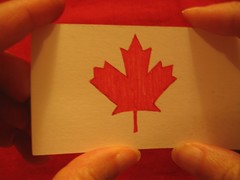
Maple Leaf Meme

Maple My Leaf

We’re playing a game. Draw the Maple Leaf.

It started with this post. I read about it here.

So draw it, then post it.

Don’t look at the real thing until you’re done.

Next up … map of Canada.

BEA Podcasts

This Friday is the start of BookExpo Canada.

A couple of weeks ago was BookExpo America. I hope that BEC does a podcast of the Friday programming, which I’m not able to attend.

Here’s what I missed at BEA, but thankfully they have a podcast.

http://www.bookexpocast.com/

Listen to Michael Cader, founder of Publishers Marketplace, interview Chris Anderson, editor-in-chief of Wired Magazine and author of The Long Tail: Why the Future of Business is Selling Less of More.

Listen to Tee Morris, co-author of Podcasting for Dummies, and Rob Simon, President of BurstMarketing talk about podcasting and how the industry should leverage podcasting for success.

Listen to John Updike lecture about books and booksellers.

And listen to other stuff about books.

Anansi Boys Tops My Charts

I just finished reading Neil Gaiman’s Anansi Boys and it is my favourite book of 2006. I know there’s still a lot of the year left but honestly I can’t imagine what its contenders could do to knock it from the top of my charts.

Anansi Boys is about two brothers: Fat Charlie Nancy and Spider Nancy. Fat Charlie is totally embarrassed by his father, who seems to be a free-wheeling, lady charmer. Fat Charlie puts a whole ocean between himself and dad. He moves to London and is engaged to Rosie. Rosie finds out that he has a father and wants him invited to the wedding. Fat Charlie has no contact info for his dad so he has to call up a long-time neighbour, Callyanne Higgler. Turns out dad is dead and Charlie needs to come home to Florida for the funeral. While he and Higgler are cleaning out dad’s house, she mentions that Charlie has a brother and if he wants to talk to him he only needs to speak to a spider. Ya right.

For very funny, drunken reasons Charlie does happen to be talking to a garden spider and says hey if you see my brother tell him to drop by. Indeed the next day Spider appears and quite quickly gets Charlie in bed with another woman, gets him investigated by the police for fraud, steals his girlfriend, and has him making deals with the bird woman.

Turns out dad is a god and Spider has god-like qualities too. They each are A Nancy. Fat Charlie is a nancy in the British sense of the word. Dad is Anansi the Spider of the African/Caribbean folktales. Spider is a spin-off (ha ha ha). Anyway, this novel is magical the way that The Time Traveler’s Wife or Our Lady of the Lost and Found is magical. The magic and fantasy are part of the story, but the writing is not what people typically imagine when they think “fantasty writing”.

The Time Traveler’s Wife and Our Lady of the Lost and Found were previous years’ top favourites so I’m now starting to see a trend with my own reading that I never saw before. Thank you blog.

In short, if you have not read Neil Gaiman or The Anansi Boys, get out and read this book. It’s beyond fantastic.

Amazon.ca has an excerpt of the first chapter if you need to peruse of the writing. And here’s the Wikipedia entry for Anansi in case you’ve never heard of the west African trickster Anansi.

Newer posts »

© 2026 So Misguided

Theme by Anders NorenUp ↑